

Ch. 2 - Limits and Continuity
Hass - Thomas' Calculus 15th Edition
Hass15th EditionThomas' CalculusISBN: 9780137616077당신이 사용하는 게 아니라요?교과서 변경
2장, 문제 2.5.2

In Exercises 1–4, say whether the function graphed is continuous on [−1, 3]. If not, where does it fail to be continuous and why?
<IMAGE>

검증된 단계별 안내
1
Step 1: Understand the definition of continuity. A function is continuous on an interval if it is continuous at every point in that interval. A function is continuous at a point if the limit of the function as it approaches the point from both sides is equal to the function's value at that point.
Step 2: Identify the interval of interest, which is [-1, 3]. This means we need to check the continuity of the function at every point within this interval, including the endpoints -1 and 3.
Step 3: Examine the graph of the function over the interval [-1, 3]. Look for any breaks, jumps, or holes in the graph, as these indicate points of discontinuity.
Step 4: Check the endpoints of the interval. Ensure that the function is defined at x = -1 and x = 3, and that the limits from the left and right at these points match the function's value at these points.
Step 5: Identify any specific points within the interval where the function might not be continuous. This could be due to a jump discontinuity, an infinite discontinuity, or a removable discontinuity. Note these points and the reasons for discontinuity, if any.

비슷한 문제에 대한 검증된 영상 답변:

이 영상 해법은 위 문제에 도움이 된다고 튜터들이 추천한 것입니다.
영상 길이:
3m
도움이 되었나요?

주요 개념

질문에 올바르게 답하기 위해 반드시 이해해야 하는 핵심 개념들은 다음과 같습니다.

Continuity of Functions

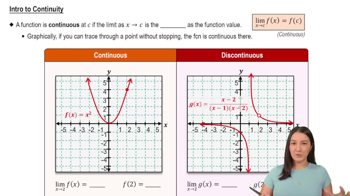
A function is continuous on an interval if it is defined at every point in that interval and does not have any breaks, jumps, or holes. Specifically, for a function to be continuous at a point, the limit of the function as it approaches that point must equal the function's value at that point.
추천 영상:
05:34
Intro to Continuity

Types of Discontinuities

Discontinuities can be classified into three main types: removable, jump, and infinite. A removable discontinuity occurs when a function is not defined at a point but can be made continuous by defining it appropriately. A jump discontinuity happens when the left-hand and right-hand limits at a point do not match, while an infinite discontinuity occurs when the function approaches infinity at a certain point.
추천 영상:
05:25
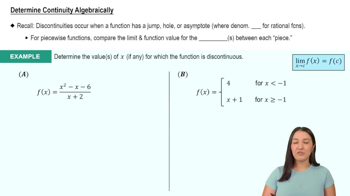
Determine Continuity Algebraically

Evaluating Limits

To determine continuity, evaluating limits is essential. The limit of a function as it approaches a point from both sides must exist and be equal to the function's value at that point. If the limits differ or do not exist, the function is discontinuous at that point, which can help identify where the function fails to be continuous.
추천 영상:
05:50
One-Sided Limits