Ch. 2 - Limits and Continuity
Hass - Thomas' Calculus 15th Edition
Hass15th EditionThomas' CalculusISBN: 9780137616077당신이 사용하는 게 아니라요?교과서 변경
2장, 문제 2.6.77

In Exercises 77–80, find a function that satisfies the given conditions and sketch its graph. (The answers here are not unique. Any function that satisfies the conditions is acceptable. Feel free to use formulas defined in pieces if that will help.)


lim x → ±∞ f(x) = 0, lim x → 2⁻ f(x) = ∞, and lim x → 2⁺ f(x) = ∞

검증된 단계별 안내
1
First, let's understand the conditions given for the function f(x). The condition lim x → ±∞ f(x) = 0 suggests that as x approaches positive or negative infinity, the function approaches zero. This is characteristic of functions that have horizontal asymptotes at y = 0.
Next, consider the condition lim x → 2⁻ f(x) = ∞ and lim x → 2⁺ f(x) = ∞. These conditions indicate that as x approaches 2 from the left and right, the function approaches infinity. This suggests a vertical asymptote at x = 2.
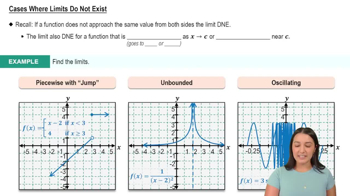
A function that satisfies these conditions could be a rational function with a vertical asymptote at x = 2 and horizontal asymptotes at y = 0. One example is f(x) = 1/(x-2)^2. This function has a vertical asymptote at x = 2 and approaches zero as x approaches ±∞.
To sketch the graph of f(x) = 1/(x-2)^2, note that the graph will have a vertical asymptote at x = 2, meaning the function will shoot up to infinity as x approaches 2 from either side. The graph will also approach the x-axis (y = 0) as x moves towards positive or negative infinity.
Finally, verify the behavior of the function at the asymptotes. As x approaches 2 from the left (x → 2⁻), f(x) = 1/(x-2)^2 tends to infinity, and similarly, as x approaches 2 from the right (x → 2⁺), f(x) also tends to infinity. As x approaches ±∞, f(x) approaches 0, confirming the horizontal asymptote at y = 0.

비슷한 문제에 대한 검증된 영상 답변:

이 영상 해법은 위 문제에 도움이 된다고 튜터들이 추천한 것입니다.
영상 길이:
2m
도움이 되었나요?

주요 개념

질문에 올바르게 답하기 위해 반드시 이해해야 하는 핵심 개념들은 다음과 같습니다.

Limits at Infinity

Limits at infinity describe the behavior of a function as the input approaches positive or negative infinity. In this context, lim x → ±∞ f(x) = 0 indicates that as x becomes very large or very small, the function f(x) approaches zero. This often suggests a horizontal asymptote at y = 0, which is crucial for sketching the graph of the function.
추천 영상:
03:07
Cases Where Limits Do Not Exist

Vertical Asymptotes

A vertical asymptote occurs when a function approaches infinity as the input approaches a specific value. Here, lim x → 2⁻ f(x) = ∞ and lim x → 2⁺ f(x) = ∞ indicate that the function has a vertical asymptote at x = 2. This means the function's value increases without bound as x approaches 2 from either direction, which is essential for understanding the function's behavior near this point.
추천 영상:
3:40
Introduction to Cotangent Graph Example 1

Piecewise Functions

Piecewise functions are defined by different expressions over different intervals of the domain. In this problem, using a piecewise function can help construct a function that meets the given conditions, such as having different behaviors near x = 2 and as x approaches infinity. This flexibility allows for creating a function that satisfies all specified limits and asymptotic behaviors.
추천 영상:
05:36
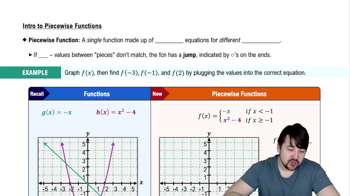
Piecewise Functions