Ch. 2 - Limits and Continuity
Hass - Thomas' Calculus 15th Edition
Hass15th EditionThomas' CalculusISBN: 9780137616077당신이 사용하는 게 아니라요?교과서 변경
2장, 문제 2.2.57

Limits of Average Rates of Change


Because of their connection with secant lines, tangents, and instantaneous rates, limits of the form limh→0 (f(x+h) − f(x)) / h occur frequently in calculus. In Exercises 57–62, evaluate this limit for the given value of x and function f.


f(x) = x², x = 1

검증된 단계별 안내
1
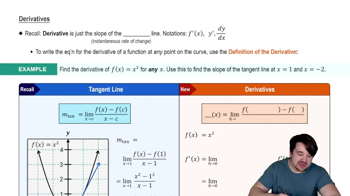
First, understand that the expression limh→0 (f(x+h) − f(x)) / h represents the derivative of the function f(x) at a specific point x. This is the definition of the derivative using the limit process.
Identify the function f(x) = x² and the point x = 1 where you need to evaluate the limit. This means you are finding the derivative of f(x) = x² at x = 1.
Substitute f(x) = x² into the limit expression: limh→0 ((1+h)² − 1²) / h. This involves substituting x = 1 into the function and considering the increment h.
Expand the expression (1+h)² to get 1 + 2h + h². This is a crucial step to simplify the expression inside the limit.
Simplify the expression: ((1 + 2h + h²) − 1) / h, which reduces to (2h + h²) / h. Then, factor out h from the numerator to get h(2 + h) / h, and cancel h from the numerator and denominator, leaving 2 + h. Finally, evaluate the limit as h approaches 0, which gives the derivative at x = 1.

비슷한 문제에 대한 검증된 영상 답변:

이 영상 해법은 위 문제에 도움이 된다고 튜터들이 추천한 것입니다.
영상 길이:
3m
도움이 되었나요?

주요 개념

질문에 올바르게 답하기 위해 반드시 이해해야 하는 핵심 개념들은 다음과 같습니다.

Limits

In calculus, a limit describes the value that a function approaches as the input approaches a certain point. It is fundamental for understanding continuity, derivatives, and integrals. The notation lim h→0 indicates that we are examining the behavior of a function as the variable h approaches zero, which is crucial for defining instantaneous rates of change.
추천 영상:
05:50
One-Sided Limits

Derivative

The derivative of a function at a point represents the instantaneous rate of change of the function with respect to its variable. It is defined as the limit of the average rate of change (the slope of the secant line) as the interval approaches zero. For the function f(x) = x², the derivative at x = 1 can be found using the limit definition, yielding the slope of the tangent line at that point.
추천 영상:

Secant and Tangent Lines

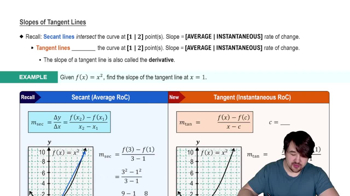
A secant line intersects a curve at two or more points, providing an average rate of change between those points. In contrast, a tangent line touches the curve at a single point and represents the instantaneous rate of change at that point. The relationship between secant and tangent lines is essential in calculus, as the limit of the secant line's slope as the two points converge gives the derivative.
추천 영상:
가이드 코스
05:13
Slopes of Tangent Lines