

Ch. 2 - Limits and Continuity
Hass - Thomas' Calculus 15th Edition
Hass15th EditionThomas' CalculusISBN: 9780137616077당신이 사용하는 게 아니라요?교과서 변경
2장, 문제 2.1.8

Slope of a Curve at a Point


In Exercises 7–18, use the method in Example 3 to find (a) the slope of the curve at the given point P, and (b) an equation of the tangent line at P.


y=7−x², P(2,3)

검증된 단계별 안내
1
First, identify the function given: \( y = 7 - x^2 \). This is a quadratic function, and we need to find its derivative to determine the slope of the curve at point P.
To find the slope of the curve at point P, calculate the derivative of the function \( y = 7 - x^2 \) with respect to \( x \). The derivative, \( \frac{dy}{dx} \), represents the slope of the tangent line at any point \( x \).
The derivative of \( y = 7 - x^2 \) is \( \frac{dy}{dx} = -2x \). This derivative gives us the slope of the curve at any point \( x \).
Substitute \( x = 2 \) into the derivative \( \frac{dy}{dx} = -2x \) to find the slope at point P(2, 3). This will give you the slope of the tangent line at that specific point.
To find the equation of the tangent line at point P, use the point-slope form of the equation of a line: \( y - y_1 = m(x - x_1) \), where \( m \) is the slope found in the previous step, and \( (x_1, y_1) \) is the point P(2, 3). Substitute the values to get the equation of the tangent line.

비슷한 문제에 대한 검증된 영상 답변:

이 영상 해법은 위 문제에 도움이 된다고 튜터들이 추천한 것입니다.
영상 길이:
4m
도움이 되었나요?

주요 개념

질문에 올바르게 답하기 위해 반드시 이해해야 하는 핵심 개념들은 다음과 같습니다.

Derivative

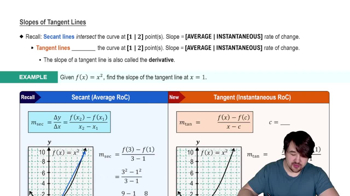
The derivative of a function at a point measures the rate at which the function's value changes as its input changes. It is defined as the limit of the average rate of change of the function over an interval as the interval approaches zero. In the context of a curve, the derivative at a specific point gives the slope of the tangent line to the curve at that point.
추천 영상:
05:44
Derivatives

Tangent Line

A tangent line to a curve at a given point is a straight line that touches the curve at that point without crossing it. The slope of the tangent line is equal to the derivative of the function at that point. The equation of the tangent line can be expressed in point-slope form, which utilizes the slope and the coordinates of the point of tangency.
추천 영상:
05:13
Slopes of Tangent Lines

Point-Slope Form

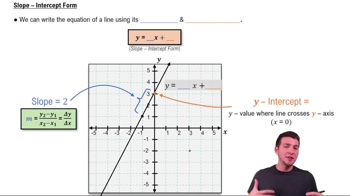
The point-slope form of a linear equation is given by y - y₁ = m(x - x₁), where (x₁, y₁) is a point on the line and m is the slope. This form is particularly useful for writing the equation of a tangent line once the slope and the point of tangency are known. It allows for a straightforward way to express the line based on its slope and a specific point.
추천 영상:
가이드 코스
3:56
Slope-Intercept Form
관련 실천
교과서 질문

Using the Formal Definition


Each of Exercises 31–36 gives a function f(x), a point c, and a positive number ε. Find L = lim x→c f(x). Then find a number δ > 0 such that |f(x)−L| < ε whenever 0 < |x−c| < δ.


f(x) = −3x − 2, c = −1, ε = 0.03

299
views
교과서 질문

Horizontal and Vertical Asymptotes

Assume that constants a and b are positive. Find equations for all horizontal and vertical asymptotes for the graph of y = (√ax² + 4) / (x―b) .

266
views
교과서 질문

Finding Limits of Differences When x → ±∞


Find the limits in Exercises 84–90. (Hint: Try multiplying and dividing by the conjugate.)


lim x → −∞ (2x + √(4x² + 3x − 2))

289
views
교과서 질문

Using the Sandwich Theorem


If 2−x² ≤ g(x) ≤ 2cosx for all x, find limx→0 g(x).

364
views
교과서 질문

Limits as x → ∞ or x → −∞


The process by which we determine limits of rational functions applies equally well to ratios containing noninteger or negative powers of x. Divide numerator and denominator by the highest power of x in the denominator and proceed from there. Find the limits in Exercises 23–36. Write ∞ or −∞ where appropriate.


lim x→∞ √(x² + 1) / (x + 1)

269
views
교과서 질문

Finding Deltas Algebraically


Each of Exercises 15–30 gives a function f(x) and numbers L, c, and ε>0. In each case, find the largest open interval about c on which the inequality |f(x)−L| <ε holds. Then give a value for δ>0 such that for all x satisfying 0 < |x−c| < δ, the inequality |f(x)−L| < ε holds.


f(x) = 1/x, L = 1/4, c = 4, ε = 0.05

313
views