

Ch. 2 - Limits and Continuity
Hass - Thomas' Calculus 15th Edition
Hass15th EditionThomas' CalculusISBN: 9780137616077당신이 사용하는 게 아니라요?교과서 변경
2장, 문제 25b

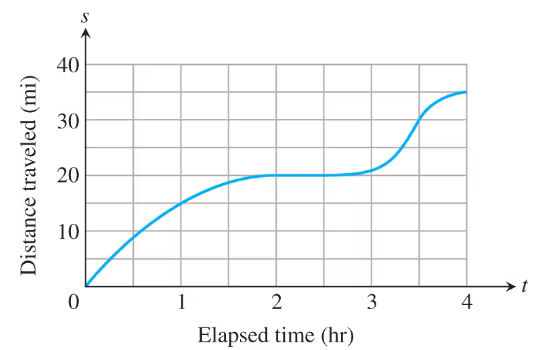
The accompanying graph shows the total distance s traveled by a bicyclist after t hours.
img
b. Estimate the bicyclist’s instantaneous speed at the times t=1/2, t=2, and t=3.

검증된 단계별 안내
1
To estimate the bicyclist's instantaneous speed at a given time, we need to find the derivative of the distance function s with respect to time t, which represents the speed. This is done by calculating the slope of the tangent line to the curve at the specified time.
For t = 1/2, identify the point on the graph where t = 1/2 and draw a tangent line at this point. Estimate the slope of this tangent line by choosing two points on the tangent line and using the formula for slope: \( \text{slope} = \frac{\Delta s}{\Delta t} \).
Repeat the process for t = 2. Locate the point on the graph where t = 2, draw the tangent line, and estimate its slope using two points on the tangent line.
Similarly, for t = 3, find the point on the graph where t = 3, draw the tangent line, and estimate the slope using two points on the tangent line.
The estimated slopes at t = 1/2, t = 2, and t = 3 will give you the bicyclist's instantaneous speeds at these times. Remember, the slope of the tangent line at a point on the graph of a function is the derivative of the function at that point, which represents the instantaneous rate of change.

비슷한 문제에 대한 검증된 영상 답변:

이 영상 해법은 위 문제에 도움이 된다고 튜터들이 추천한 것입니다.
영상 길이:
2m
도움이 되었나요?

주요 개념

질문에 올바르게 답하기 위해 반드시 이해해야 하는 핵심 개념들은 다음과 같습니다.

Instantaneous Speed

Instantaneous speed refers to the speed of an object at a specific moment in time. In calculus, it is determined by finding the derivative of the position function with respect to time. This derivative gives the rate of change of distance with respect to time, allowing us to calculate how fast the bicyclist is moving at particular instances.
추천 영상:
가이드 코스
06:29
Derivatives Applied To Velocity

Derivative

The derivative is a fundamental concept in calculus that measures how a function changes as its input changes. It represents the slope of the tangent line to the graph of the function at a given point. In the context of the bicyclist's distance function, the derivative at a specific time gives the instantaneous speed at that moment.
추천 영상:

Graph Interpretation

Interpreting graphs is crucial in calculus as it allows us to visualize relationships between variables. In this case, the graph of total distance versus time helps us understand how the bicyclist's speed changes over time. By analyzing the slope of the graph at specific points, we can estimate the instantaneous speed at those times.
추천 영상:
가이드 코스
06:15
Graphing The Derivative
관련 실천
교과서 질문

[Technology Exercise] Let f(t) = 1/t for t≠0.


a. Find the average rate of change of f with respect to t over the intervals (i) from t=2 to t=3, and (ii) from t=2 to t=T.


b. Make a table of values of the average rate of change of f with respect to t over the interval [2,T], for some values of T approaching 2, say T = 2.1, 2.01, 2.001, 2.0001, 2.00001, and 2.000001.


c. What does your table indicate is the rate of change of f with respect to t at t=2?

298
views
교과서 질문

[Technology Exercise] Roots


Let ƒ(𝓍) = 𝓍³ ―𝓍― 1.


b. Solve the equation ƒ(𝓍) = 0 graphically with an error of magnitude at most 10⁻⁸ .

175
views
교과서 질문

Finding Limits

In Exercises 9–24, find the limit or explain why it does not exist.


lim x →π cos² (x― tan x)

210
views
교과서 질문

The accompanying graph shows the total amount of gasoline A in the gas tank of an automobile after it has been driven for t days.

c. Estimate the maximum rate of gasoline consumption and the specific time at which it occurs.

315
views
교과서 질문

Finding Deltas Algebraically


Each of Exercises 15–30 gives a function f(x) and numbers L, c, and ε>0. In each case, find the largest open interval about c on which the inequality |f(x)−L| <ε holds. Then give a value for δ>0 such that for all x satisfying 0 < |x−c| < δ, the inequality |f(x)−L| < ε holds.


f(x) = mx, m > 0, L = 2m, c = 2, ε = 0.03

306
views
교과서 질문

Finding Limits


In Exercises 9–24, find the limit or explain why it does not exist.


lim x →π sin (x/2 + sin x)

285
views