Ch. 3 - Derivatives
Hass - Thomas' Calculus 15th Edition
Hass15th EditionThomas' CalculusISBN: 9780137616077당신이 사용하는 게 아니라요?교과서 변경
3장, 문제 3.68

a. Graph the function


ƒ(x) = { x, -1 ≤ x < 0
{ tan x, 0 ≤ x ≤ π/4.


b. Is ƒ continuous at x = 0?
c. Is ƒ differentiable at x = 0?


Give reasons for your answers.

검증된 단계별 안내
1
Step 1: To graph the function ƒ(x), first consider the piecewise definition. For the interval -1 ≤ x < 0, the function is ƒ(x) = x, which is a linear function. Plot this part of the graph as a straight line starting at x = -1 and ending just before x = 0.
Step 2: For the interval 0 ≤ x ≤ π/4, the function is ƒ(x) = tan(x). Plot this part of the graph starting at x = 0 and ending at x = π/4. Note that tan(x) is continuous and differentiable within this interval.
Step 3: To determine if ƒ is continuous at x = 0, check the left-hand limit and right-hand limit as x approaches 0. The left-hand limit is the value of ƒ(x) as x approaches 0 from the left, which is 0. The right-hand limit is the value of ƒ(x) as x approaches 0 from the right, which is tan(0) = 0. Since both limits are equal and ƒ(0) = tan(0) = 0, ƒ is continuous at x = 0.
Step 4: To determine if ƒ is differentiable at x = 0, check the derivative from the left and right. The derivative of ƒ(x) = x for x < 0 is 1, and the derivative of ƒ(x) = tan(x) for x > 0 is sec²(x). Evaluate sec²(x) at x = 0, which is 1. Since both derivatives are equal at x = 0, ƒ is differentiable at x = 0.
Step 5: Summarize the findings: The function ƒ(x) is continuous at x = 0 because the left-hand limit, right-hand limit, and ƒ(0) are all equal. It is differentiable at x = 0 because the derivatives from the left and right are equal at that point.

비슷한 문제에 대한 검증된 영상 답변:

이 영상 해법은 위 문제에 도움이 된다고 튜터들이 추천한 것입니다.
영상 길이:
2m
도움이 되었나요?

주요 개념

질문에 올바르게 답하기 위해 반드시 이해해야 하는 핵심 개념들은 다음과 같습니다.

Piecewise Functions

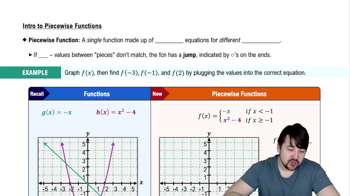
A piecewise function is defined by different expressions based on the input value. In this case, the function ƒ(x) has two distinct parts: one for values of x from -1 to 0, and another for values from 0 to π/4. Understanding how to evaluate and graph each piece is crucial for analyzing the overall behavior of the function.
추천 영상:
05:36
Piecewise Functions

Continuity

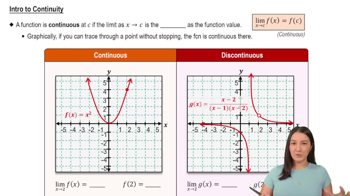
A function is continuous at a point if the limit of the function as it approaches that point equals the function's value at that point. For ƒ(x) to be continuous at x = 0, we need to check if the left-hand limit (as x approaches 0 from the left) equals the right-hand limit (as x approaches 0 from the right) and if both equal ƒ(0).
추천 영상:
05:34
Intro to Continuity

Differentiability

A function is differentiable at a point if it has a defined derivative at that point, which requires the function to be continuous there. To determine if ƒ(x) is differentiable at x = 0, we must examine the left-hand and right-hand derivatives at that point and see if they are equal. If they differ, the function is not differentiable at that point.
추천 영상:
05:53
Finding Differentials