
Ch. 3 - Derivatives
Hass - Thomas' Calculus 15th Edition
Hass15th EditionThomas' CalculusISBN: 9780137616077당신이 사용하는 게 아니라요?교과서 변경
3장, 문제 55a

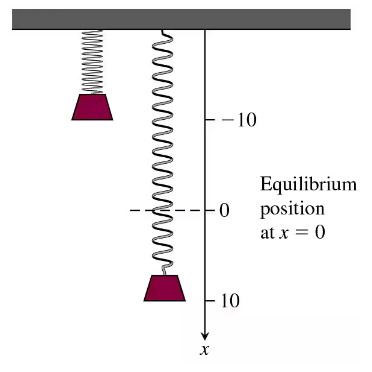
A weight is attached to a spring and reaches its equilibrium position (x = 0). It is then set in motion resulting in a displacement of x = 10 cos t, where x is measured in centimeters and t is measured in seconds. See the accompanying figure.
img
Find the spring’s displacement when t = 0, t = π/3, and t = 3π/4.

검증된 단계별 안내
1
Identify the displacement function given in the problem: x(t) = 10 cos(t). This function describes the displacement of the spring from its equilibrium position over time.
To find the displacement at a specific time, substitute the given time value into the displacement function. Start with t = 0: x(0) = 10 cos(0).
Evaluate the cosine function at t = 0. Recall that cos(0) = 1, so x(0) = 10 * 1.
Next, substitute t = π/3 into the displacement function: x(π/3) = 10 cos(π/3).
Evaluate the cosine function at t = π/3. Recall that cos(π/3) = 1/2, so x(π/3) = 10 * 1/2.

비슷한 문제에 대한 검증된 영상 답변:

이 영상 해법은 위 문제에 도움이 된다고 튜터들이 추천한 것입니다.
영상 길이:
1m
도움이 되었나요?

주요 개념

질문에 올바르게 답하기 위해 반드시 이해해야 하는 핵심 개념들은 다음과 같습니다.

Equilibrium Position

The equilibrium position of a spring is the point where the net force acting on the spring is zero. In this context, it is represented by x = 0, where the spring is neither compressed nor stretched. When a weight is attached and set in motion, it oscillates around this equilibrium point, demonstrating simple harmonic motion.
추천 영상:
가이드 코스
05:40
Work Done On A Spring (Hooke's Law)

Simple Harmonic Motion (SHM)

Simple Harmonic Motion is a type of periodic motion where an object moves back and forth around an equilibrium position. The displacement of the object can be described by a cosine or sine function, such as x = 10 cos(t), indicating that the motion is sinusoidal and the object oscillates with a specific amplitude and period.
추천 영상:
가이드 코스
06:51
Derivatives Applied To Acceleration Example 2

Trigonometric Functions

Trigonometric functions, such as cosine and sine, are fundamental in describing oscillatory motion. In this case, the displacement of the spring is given by x = 10 cos(t), where the cosine function determines the position of the spring at any time t. Understanding these functions is crucial for calculating the displacement at specific time intervals.
추천 영상:
가이드 코스
6:04
Introduction to Trigonometric Functions
관련 실천
교과서 질문

When the length L of a clock pendulum is held constant by controlling its temperature, the pendulum’s period T depends on the acceleration of gravity g. The period will therefore vary slightly as the clock is moved from place to place on Earth’s surface, depending on the change in g. By keeping track of ΔT, we can estimate the variation in g from the equation T = 2π(L/g)¹/² that relates T, g, and L.


a. With L held constant and g as the independent variable, calculate dT and use it to answer parts (b) and (c).

165
views
교과서 질문

a. Find an equation for the line that is tangent to the curve y = x³ − 6x² + 5x at the origin.

[Technology Exercise] b. Graph the curve and tangent line together. The tangent line intersects the curve at another point. Use Zoom and Trace to estimate the point’s coordinates.

[Technology Exercise] c. Confirm your estimates of the coordinates of the second intersection point by solving the equations for the curve and tangent line simultaneously.

215
views
교과서 질문

When the length L of a clock pendulum is held constant by controlling its temperature, the pendulum’s period T depends on the acceleration of gravity g. The period will therefore vary slightly as the clock is moved from place to place on Earth’s surface, depending on the change in g. By keeping track of ΔT, we can estimate the variation in g from the equation T = 2π(L/g)¹/² that relates T, g, and L.


b. If g increases, will T increase or decrease? Will a pendulum clock speed up or slow down? Explain.

206
views
교과서 질문

Quadratic approximations


[Technology Exercise] c. Graph f(x) = 1/(1 − x) and its quadratic approximation at x = 0. Then zoom in on the two graphs at the point (0,1). Comment on what you see.

198
views
교과서 질문

A weight is attached to a spring and reaches its equilibrium position (x = 0). It is then set in motion resulting in a displacement of x = 10 cos t, where x is measured in centimeters and t is measured in seconds. See the accompanying figure.

b. Find the spring’s velocity when t = 0, t = π/3, and t = 3π/4.

225
views
교과서 질문

Quadratic approximations


d. Find the quadratic approximation to g(x) = 1/x at x = 1. Graph g and its quadratic approximation together. Comment on what you see

208
views