

Tolerance The height and radius of a right circular cylinder are equal, so the cylinder’s volume is V = πh³. The volume is to be calculated with an error of no more than 1% of the true value. Find approximately the greatest error that can be tolerated in the measurement of h, expressed as a percentage of h.
Ch. 3 - Derivatives
3장, 문제 3.7.2
Differentiating Implicitly
Use implicit differentiation to find dy/dx in Exercises 1–14.
x³ + y³ = 18xy
검증된 단계별 안내1
Start by differentiating both sides of the equation with respect to x. The equation is x³ + y³ = 18xy.
Differentiate x³ with respect to x, which gives 3x².
Differentiate y³ with respect to x using implicit differentiation. Since y is a function of x, this gives 3y²(dy/dx).
Differentiate 18xy with respect to x. Use the product rule: differentiate 18x to get 18, and multiply by y, then differentiate y to get dy/dx and multiply by 18x. This results in 18y + 18x(dy/dx).
Set the derivatives equal: 3x² + 3y²(dy/dx) = 18y + 18x(dy/dx). Solve for dy/dx by isolating terms involving dy/dx on one side of the equation.

비슷한 문제에 대한 검증된 영상 답변:
이 영상 해법은 위 문제에 도움이 된다고 튜터들이 추천한 것입니다.
영상 길이:
4m도움이 되었나요?
주요 개념
질문에 올바르게 답하기 위해 반드시 이해해야 하는 핵심 개념들은 다음과 같습니다.
Implicit Differentiation
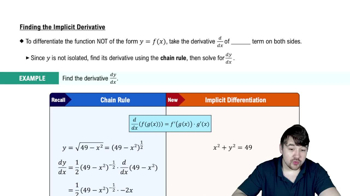
Implicit differentiation is a technique used to differentiate equations where the dependent variable is not isolated on one side. Instead of solving for y explicitly, we differentiate both sides of the equation with respect to x, applying the chain rule to terms involving y. This allows us to find dy/dx without needing to express y as a function of x.
추천 영상:
Finding The Implicit Derivative
Chain Rule
The chain rule is a fundamental principle in calculus that allows us to differentiate composite functions. When differentiating a function of another function, the chain rule states that the derivative is the product of the derivative of the outer function and the derivative of the inner function. In implicit differentiation, this is particularly important when differentiating terms involving y, as we treat dy/dx as the derivative of y with respect to x.
추천 영상:
Intro to the Chain Rule
Solving for dy/dx
After applying implicit differentiation to an equation, the next step is to isolate dy/dx. This often involves rearranging the differentiated equation to express dy/dx in terms of x and y. Once isolated, dy/dx provides the slope of the tangent line to the curve defined by the original equation at any point (x, y).
추천 영상:
Solving Logarithmic Equations
관련 실천
교과서 질문
236
views
교과서 질문
In Exercises 11–18, find the slope of the function’s graph at the given point. Then find an equation for the line tangent to the graph there.
f(x) = √(x + 1), (8, 3)
229
views
교과서 질문
Tangent line to y = √x Does any tangent line to the curve y = √x cross the x-axis at x = −1? If so, find an equation for the line and the point of tangency. If not, why not?
240
views
교과서 질문
Differentiating Implicitly
Use implicit differentiation to find dy/dx in Exercises 1–14.
x²y + xy² = 6
252
views
교과서 질문
Derivative Calculations
In Exercises 1–8, given y = f(u) and u = g(x), find dy/dx = f'(g(x)) g'(x).
y = sin u, u = 3x + 1
298
views
교과서 질문
Find the points on the curve y = tan x, -π/2 < x < π/2, where the normal line is parallel to the line y = -x/2. Sketch the curve and normal lines together, labeling each with its equation.
166
views
