


Ch. 3 - Derivatives
Hass - Thomas' Calculus 15th Edition
Hass15th EditionThomas' CalculusISBN: 9780137616077당신이 사용하는 게 아니라요?교과서 변경
3장, 문제 21c

Economics


Marginal cost Suppose that the dollar cost of producing x washing machines is c(x) = 2000 + 100x − 0.1x².


c. Show that the marginal cost when 100 washing machines are produced is approximately the cost of producing one more washing machine after the first 100 have been made, by calculating the latter cost directly.

검증된 단계별 안내
1
First, understand that the marginal cost is the derivative of the cost function c(x) with respect to x. This represents the rate of change of the cost with respect to the number of washing machines produced.
Calculate the derivative of the cost function c(x) = 2000 + 100x - 0.1x². The derivative, c'(x), will give us the marginal cost function.
Differentiate c(x) with respect to x: c'(x) = d/dx [2000 + 100x - 0.1x²]. Use the power rule for differentiation: the derivative of a constant is 0, the derivative of 100x is 100, and the derivative of -0.1x² is -0.2x.
Substitute x = 100 into the marginal cost function c'(x) to find the marginal cost when 100 washing machines are produced. This will give us c'(100).
To verify, calculate the cost of producing the 101st washing machine directly by finding the difference: c(101) - c(100). Compare this value to c'(100) to show that the marginal cost approximates the cost of producing one more washing machine after the first 100.

비슷한 문제에 대한 검증된 영상 답변:

이 영상 해법은 위 문제에 도움이 된다고 튜터들이 추천한 것입니다.
영상 길이:
3m

주요 개념

질문에 올바르게 답하기 위해 반드시 이해해야 하는 핵심 개념들은 다음과 같습니다.

Marginal Cost

Marginal cost refers to the additional cost incurred in producing one more unit of a good. It is derived from the cost function and is crucial for understanding how costs change with production levels. In calculus, it is represented as the derivative of the cost function with respect to the quantity produced, providing an instantaneous rate of change of cost.
추천 영상:
07:32
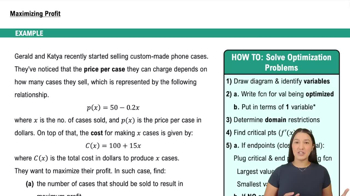
Example 3: Maximizing Profit

Derivative

The derivative of a function at a point measures the rate at which the function's value changes as its input changes. In the context of cost functions, the derivative represents the marginal cost, indicating how the total cost changes with a small change in the number of units produced. Calculating the derivative of the cost function c(x) gives the marginal cost function.
추천 영상:

Evaluating the Derivative at a Point

To find the marginal cost at a specific production level, evaluate the derivative of the cost function at that point. This involves substituting the given production quantity into the marginal cost function. For example, to find the marginal cost when 100 washing machines are produced, substitute x = 100 into the derivative of c(x) to determine the cost of producing one additional unit.
추천 영상:
04:50
Critical Points