Ch. 3 - Derivatives
Hass - Thomas' Calculus 15th Edition
Hass15th EditionThomas' CalculusISBN: 9780137616077당신이 사용하는 게 아니라요?교과서 변경
3장, 문제 3.6.78

Find dy/dt when x = 1 if y = x² + 7x − 5 and dx/dt = ¹/₃.

검증된 단계별 안내
1
First, identify the given function y = x² + 7x − 5. This is the function for which we need to find the derivative with respect to time, t.
To find dy/dt, use the chain rule. The chain rule states that dy/dt = (dy/dx) * (dx/dt). We need to find dy/dx first.
Differentiate y = x² + 7x − 5 with respect to x to find dy/dx. The derivative of x² is 2x, and the derivative of 7x is 7. Therefore, dy/dx = 2x + 7.
Substitute x = 1 into the expression for dy/dx to find the specific value of the derivative at x = 1. This gives dy/dx = 2(1) + 7.
Now, substitute dy/dx and dx/dt = ¹/₃ into the chain rule formula: dy/dt = (dy/dx) * (dx/dt). Calculate dy/dt using the values obtained in the previous steps.

비슷한 문제에 대한 검증된 영상 답변:

이 영상 해법은 위 문제에 도움이 된다고 튜터들이 추천한 것입니다.
영상 길이:
2m
도움이 되었나요?

주요 개념

질문에 올바르게 답하기 위해 반드시 이해해야 하는 핵심 개념들은 다음과 같습니다.

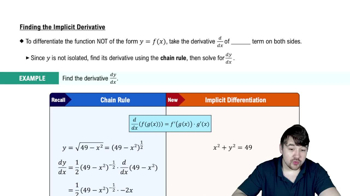
Implicit Differentiation

Implicit differentiation is a technique used to find the derivative of a function when it is not explicitly solved for one variable in terms of another. In this context, it helps us differentiate y with respect to t by considering the relationship between x and y, and using the chain rule to account for dx/dt.
추천 영상:
가이드 코스
05:14
Finding The Implicit Derivative

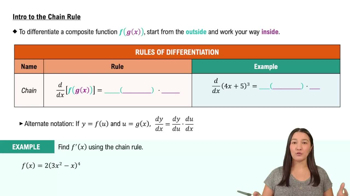
Chain Rule

The chain rule is a fundamental concept in calculus used to differentiate composite functions. It states that the derivative of a composite function is the derivative of the outer function evaluated at the inner function times the derivative of the inner function. Here, it allows us to find dy/dt by multiplying dy/dx by dx/dt.
추천 영상:
05:02
Intro to the Chain Rule

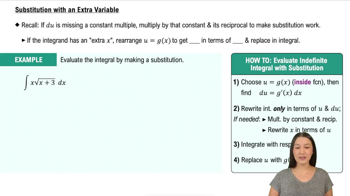
Substitution

Substitution involves replacing variables with known values to simplify expressions or solve equations. In this problem, after finding the expression for dy/dt, we substitute x = 1 and dx/dt = 1/3 to calculate the specific value of dy/dt at that point, providing a concrete solution to the problem.
추천 영상:
04:27
Substitution With an Extra Variable