Ch. 3 - Derivatives
3์žฅ, ๋ฌธ์ œ 3.21

Find the derivatives of the functions in Exercises 1โ€“42.


๐”‚ = 1 xยฒ csc 2
2 x

๊ฒ€์ฆ๋œ ๋‹จ๊ณ„๋ณ„ ์•ˆ๋‚ด
1
Step 1: Identify the function components. The given function is \( y = \frac{1}{x^2} \csc(2x) \). This is a product of two functions: \( u(x) = \frac{1}{x^2} \) and \( v(x) = \csc(2x) \).
Step 2: Apply the product rule for differentiation. The product rule states that if \( y = u(x) \cdot v(x) \), then \( y' = u'(x) \cdot v(x) + u(x) \cdot v'(x) \).
Step 3: Differentiate \( u(x) = \frac{1}{x^2} \). Use the power rule: \( u'(x) = -2x^{-3} \).
Step 4: Differentiate \( v(x) = \csc(2x) \). Use the chain rule: \( v'(x) = -2 \csc(2x) \cot(2x) \).
Step 5: Substitute \( u'(x) \), \( v(x) \), \( u(x) \), and \( v'(x) \) into the product rule formula to find \( y' \).

๋น„์Šทํ•œ ๋ฌธ์ œ์— ๋Œ€ํ•œ ๊ฒ€์ฆ๋œ ์˜์ƒ ๋‹ต๋ณ€:

์ด ์˜์ƒ ํ•ด๋ฒ•์€ ์œ„ ๋ฌธ์ œ์— ๋„์›€์ด ๋œ๋‹ค๊ณ  ํŠœํ„ฐ๋“ค์ด ์ถ”์ฒœํ•œ ๊ฒƒ์ž…๋‹ˆ๋‹ค.
์˜์ƒ ๊ธธ์ด:
4m
๋„์›€์ด ๋˜์—ˆ๋‚˜์š”?

์ฃผ์š” ๊ฐœ๋…

์งˆ๋ฌธ์— ์˜ฌ๋ฐ”๋ฅด๊ฒŒ ๋‹ตํ•˜๊ธฐ ์œ„ํ•ด ๋ฐ˜๋“œ์‹œ ์ดํ•ดํ•ด์•ผ ํ•˜๋Š” ํ•ต์‹ฌ ๊ฐœ๋…๋“ค์€ ๋‹ค์Œ๊ณผ ๊ฐ™์Šต๋‹ˆ๋‹ค.

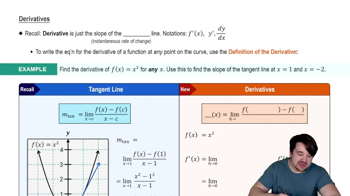
Derivatives

The derivative of a function measures how the function's output value changes as its input value changes. It is a fundamental concept in calculus, representing the slope of the tangent line to the curve of the function at any given point. Derivatives can be computed using various rules, such as the power rule, product rule, and quotient rule, depending on the form of the function.
์ถ”์ฒœ ์˜์ƒ:

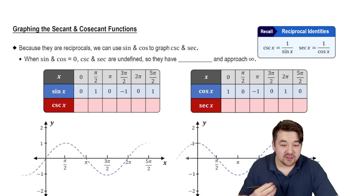
Cosecant Function (csc)

The cosecant function, denoted as csc(x), is the reciprocal of the sine function, defined as csc(x) = 1/sin(x). It is important in calculus when dealing with trigonometric functions, especially when finding derivatives. Understanding how to differentiate csc(x) and its properties is essential for solving problems involving trigonometric derivatives.
์ถ”์ฒœ ์˜์ƒ:
๊ฐ€์ด๋“œ ์ฝ”์Šค
6:22
Graphs of Secant and Cosecant Functions

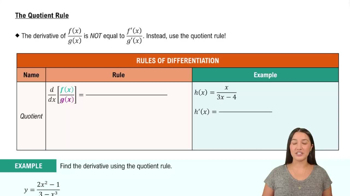
Quotient Rule

The quotient rule is a method for finding the derivative of a function that is the ratio of two other functions. If you have a function defined as f(x) = g(x)/h(x), the derivative is given by f'(x) = (g'(x)h(x) - g(x)h'(x)) / (h(x))ยฒ. This rule is crucial when differentiating functions that involve division, such as the one presented in the question.
์ถ”์ฒœ ์˜์ƒ:
06:43
The Quotient Rule