


Ch. 3 - Derivatives
3์žฅ, ๋ฌธ์ œ 3.7

Find the derivatives of the functions in Exercises 1โ€“42.


๐”‚ = (ฮธยฒ + sec ฮธ + 1)ยณ

๊ฒ€์ฆ๋œ ๋‹จ๊ณ„๋ณ„ ์•ˆ๋‚ด
1
Identify the function: We have ๐”‚ = (ฮธยฒ + sec ฮธ + 1)ยณ. This is a composite function, where the outer function is a cube and the inner function is ฮธยฒ + sec ฮธ + 1.
Apply the chain rule: The chain rule states that if you have a composite function y = f(g(x)), then the derivative y' = f'(g(x)) * g'(x). Here, f(u) = uยณ and g(ฮธ) = ฮธยฒ + sec ฮธ + 1.
Differentiate the outer function: The derivative of f(u) = uยณ with respect to u is f'(u) = 3uยฒ. Substitute u = ฮธยฒ + sec ฮธ + 1 into this derivative.
Differentiate the inner function: Find the derivative of g(ฮธ) = ฮธยฒ + sec ฮธ + 1 with respect to ฮธ. The derivative of ฮธยฒ is 2ฮธ, and the derivative of sec ฮธ is sec ฮธ tan ฮธ.
Combine the derivatives: Multiply the derivative of the outer function by the derivative of the inner function according to the chain rule. This gives you the derivative of the original function ๐”‚ with respect to ฮธ.

๋น„์Šทํ•œ ๋ฌธ์ œ์— ๋Œ€ํ•œ ๊ฒ€์ฆ๋œ ์˜์ƒ ๋‹ต๋ณ€:

์ด ์˜์ƒ ํ•ด๋ฒ•์€ ์œ„ ๋ฌธ์ œ์— ๋„์›€์ด ๋œ๋‹ค๊ณ  ํŠœํ„ฐ๋“ค์ด ์ถ”์ฒœํ•œ ๊ฒƒ์ž…๋‹ˆ๋‹ค.
์˜์ƒ ๊ธธ์ด:
2m
๋„์›€์ด ๋˜์—ˆ๋‚˜์š”?

์ฃผ์š” ๊ฐœ๋…

์งˆ๋ฌธ์— ์˜ฌ๋ฐ”๋ฅด๊ฒŒ ๋‹ตํ•˜๊ธฐ ์œ„ํ•ด ๋ฐ˜๋“œ์‹œ ์ดํ•ดํ•ด์•ผ ํ•˜๋Š” ํ•ต์‹ฌ ๊ฐœ๋…๋“ค์€ ๋‹ค์Œ๊ณผ ๊ฐ™์Šต๋‹ˆ๋‹ค.

Derivative

The derivative of a function measures how the function's output value changes as its input value changes. It is a fundamental concept in calculus that provides the slope of the tangent line to the curve at any given point. The derivative can be computed using various rules, such as the power rule, product rule, and chain rule.
์ถ”์ฒœ ์˜์ƒ:
05:44
Derivatives

Chain Rule

The chain rule is a formula for computing the derivative of the composition of two or more functions. It states that if you have a function that is composed of another function, the derivative can be found by multiplying the derivative of the outer function by the derivative of the inner function. This is particularly useful when dealing with functions raised to a power, as in the given problem.
์ถ”์ฒœ ์˜์ƒ:
05:02
Intro to the Chain Rule

Secant Function

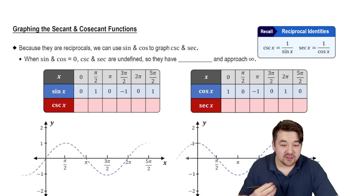
The secant function, denoted as sec(ฮธ), is the reciprocal of the cosine function, defined as sec(ฮธ) = 1/cos(ฮธ). Understanding the secant function is essential when differentiating functions that include it, as it requires the application of the quotient rule and knowledge of trigonometric derivatives. Its behavior and properties are crucial for accurately finding derivatives involving trigonometric functions.
์ถ”์ฒœ ์˜์ƒ:
6:22
Graphs of Secant and Cosecant Functions