Ch. 3 - Derivatives
3์žฅ, ๋ฌธ์ œ 3.35

Find the derivatives of the functions in Exercises 1โ€“42.


๐“ป = ( sin ฮธ )ยฒ
( cos ฮธ - 1 )

๊ฒ€์ฆ๋œ ๋‹จ๊ณ„๋ณ„ ์•ˆ๋‚ด
1
Identify the function for which you need to find the derivative. Here, the function is \( r(\theta) = (\sin \theta)^2 (\cos \theta - 1) \).
Apply the product rule for differentiation, which states that if you have a function \( u(\theta) \cdot v(\theta) \), its derivative is \( u'(\theta) \cdot v(\theta) + u(\theta) \cdot v'(\theta) \). In this case, let \( u(\theta) = (\sin \theta)^2 \) and \( v(\theta) = (\cos \theta - 1) \).
Differentiate \( u(\theta) = (\sin \theta)^2 \) using the chain rule. The chain rule states that the derivative of \( (f(g(\theta))) \) is \( f'(g(\theta)) \cdot g'(\theta) \). Here, \( f(x) = x^2 \) and \( g(\theta) = \sin \theta \). So, \( u'(\theta) = 2 \sin \theta \cdot \cos \theta \).
Differentiate \( v(\theta) = (\cos \theta - 1) \). The derivative of \( \cos \theta \) is \( -\sin \theta \), and the derivative of a constant is 0. Therefore, \( v'(\theta) = -\sin \theta \).
Substitute \( u'(\theta) \), \( u(\theta) \), \( v'(\theta) \), and \( v(\theta) \) into the product rule formula: \( r'(\theta) = [2 \sin \theta \cdot \cos \theta] \cdot (\cos \theta - 1) + (\sin \theta)^2 \cdot [-\sin \theta] \). Simplify the expression to find the derivative.

๋น„์Šทํ•œ ๋ฌธ์ œ์— ๋Œ€ํ•œ ๊ฒ€์ฆ๋œ ์˜์ƒ ๋‹ต๋ณ€:

์ด ์˜์ƒ ํ•ด๋ฒ•์€ ์œ„ ๋ฌธ์ œ์— ๋„์›€์ด ๋œ๋‹ค๊ณ  ํŠœํ„ฐ๋“ค์ด ์ถ”์ฒœํ•œ ๊ฒƒ์ž…๋‹ˆ๋‹ค.
์˜์ƒ ๊ธธ์ด:
3m
๋„์›€์ด ๋˜์—ˆ๋‚˜์š”?

์ฃผ์š” ๊ฐœ๋…

์งˆ๋ฌธ์— ์˜ฌ๋ฐ”๋ฅด๊ฒŒ ๋‹ตํ•˜๊ธฐ ์œ„ํ•ด ๋ฐ˜๋“œ์‹œ ์ดํ•ดํ•ด์•ผ ํ•˜๋Š” ํ•ต์‹ฌ ๊ฐœ๋…๋“ค์€ ๋‹ค์Œ๊ณผ ๊ฐ™์Šต๋‹ˆ๋‹ค.

Derivatives

A derivative represents the rate at which a function changes at any given point. It is a fundamental concept in calculus that provides information about the slope of the tangent line to the curve of the function. Derivatives can be computed using various rules, such as the power rule, product rule, and chain rule, depending on the form of the function.
์ถ”์ฒœ ์˜์ƒ:

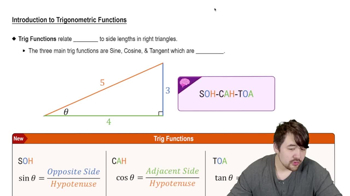
Trigonometric Functions

Trigonometric functions, such as sine and cosine, are periodic functions that relate angles to ratios of sides in right triangles. In calculus, these functions are essential for modeling oscillatory behavior and are frequently encountered in derivatives. Understanding their properties, such as their derivatives (e.g., the derivative of sin ฮธ is cos ฮธ), is crucial for solving problems involving these functions.
์ถ”์ฒœ ์˜์ƒ:
๊ฐ€์ด๋“œ ์ฝ”์Šค
6:04
Introduction to Trigonometric Functions

Polar Coordinates

Polar coordinates provide a way to represent points in a plane using a distance from a reference point and an angle from a reference direction. In the context of the given function, r = (sin ฮธ)ยฒ / (cos ฮธ - 1), understanding how to differentiate functions expressed in polar coordinates is important. The conversion between polar and Cartesian coordinates may also be necessary for certain derivative calculations.
์ถ”์ฒœ ์˜์ƒ:
06:10
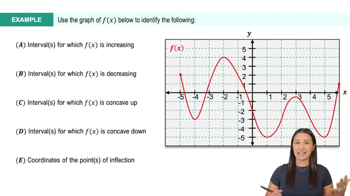
Determining Concavity from the Graph of f' or f'' Example 1