


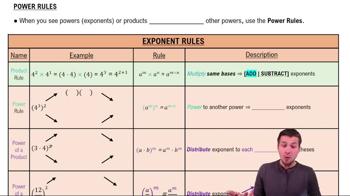
Ch. 3 - Derivatives
3์žฅ, ๋ฌธ์ œ 3.31

Find the derivatives of the functions in Exercises 1โ€“42.
__
๐”‚ = ( โˆš x )ยฒ
( 1 + x )

๊ฒ€์ฆ๋œ ๋‹จ๊ณ„๋ณ„ ์•ˆ๋‚ด
1
First, simplify the expression \( y = (\sqrt{x})^2(1 + x) \). Note that \((\sqrt{x})^2 = x\), so the function simplifies to \( y = x(1 + x) \).
Next, expand the expression \( y = x(1 + x) \) to make differentiation easier. This gives \( y = x + x^2 \).
Now, differentiate the function \( y = x + x^2 \) with respect to \( x \). Use the power rule for differentiation, which states that \( \frac{d}{dx}[x^n] = nx^{n-1} \).
Apply the power rule to each term: The derivative of \( x \) is \( 1 \), and the derivative of \( x^2 \) is \( 2x \).
Combine the derivatives of each term to find the derivative of the entire function: \( \frac{dy}{dx} = 1 + 2x \).

๋น„์Šทํ•œ ๋ฌธ์ œ์— ๋Œ€ํ•œ ๊ฒ€์ฆ๋œ ์˜์ƒ ๋‹ต๋ณ€:

์ด ์˜์ƒ ํ•ด๋ฒ•์€ ์œ„ ๋ฌธ์ œ์— ๋„์›€์ด ๋œ๋‹ค๊ณ  ํŠœํ„ฐ๋“ค์ด ์ถ”์ฒœํ•œ ๊ฒƒ์ž…๋‹ˆ๋‹ค.
์˜์ƒ ๊ธธ์ด:
6m
๋„์›€์ด ๋˜์—ˆ๋‚˜์š”?

์ฃผ์š” ๊ฐœ๋…

์งˆ๋ฌธ์— ์˜ฌ๋ฐ”๋ฅด๊ฒŒ ๋‹ตํ•˜๊ธฐ ์œ„ํ•ด ๋ฐ˜๋“œ์‹œ ์ดํ•ดํ•ด์•ผ ํ•˜๋Š” ํ•ต์‹ฌ ๊ฐœ๋…๋“ค์€ ๋‹ค์Œ๊ณผ ๊ฐ™์Šต๋‹ˆ๋‹ค.

Derivative

The derivative of a function measures how the function's output value changes as its input value changes. It is defined as the limit of the average rate of change of the function over an interval as the interval approaches zero. Derivatives are fundamental in calculus for understanding rates of change and are denoted as f'(x) or dy/dx.
์ถ”์ฒœ ์˜์ƒ:

Chain Rule

The chain rule is a formula for computing the derivative of the composition of two or more functions. It states that if you have a function g(x) that is composed with another function f(x), the derivative can be found by multiplying the derivative of the outer function by the derivative of the inner function. This is essential when differentiating functions that are nested within each other.
์ถ”์ฒœ ์˜์ƒ:
05:02
Intro to the Chain Rule

Power Rule

The power rule is a basic rule for finding the derivative of a function in the form of f(x) = x^n, where n is a real number. According to this rule, the derivative is given by f'(x) = n*x^(n-1). This rule simplifies the process of differentiation for polynomial functions and is widely used in calculus.
์ถ”์ฒœ ์˜์ƒ:
5:50
Power Rules