Ch. 3 - Derivatives
3์žฅ, ๋ฌธ์ œ 3.27

Find the derivatives of the functions in Exercises 1โ€“42.


๐”‚ = xยฒ sinยฒ (2xยฒ)

๊ฒ€์ฆ๋œ ๋‹จ๊ณ„๋ณ„ ์•ˆ๋‚ด
1
Step 1: Identify the function y = xยฒ sinยฒ(2xยฒ). Notice that this is a product of two functions: u(x) = xยฒ and v(x) = sinยฒ(2xยฒ).
Step 2: Apply the product rule for derivatives, which states that if y = u(x) * v(x), then y' = u'(x) * v(x) + u(x) * v'(x).
Step 3: Differentiate u(x) = xยฒ. The derivative u'(x) is 2x.
Step 4: Differentiate v(x) = sinยฒ(2xยฒ). Use the chain rule: v'(x) = 2 * sin(2xยฒ) * cos(2xยฒ) * (d/dx)(2xยฒ).
Step 5: Calculate (d/dx)(2xยฒ), which is 4x. Substitute back into the expression for v'(x) to get v'(x) = 2 * sin(2xยฒ) * cos(2xยฒ) * 4x.

๋น„์Šทํ•œ ๋ฌธ์ œ์— ๋Œ€ํ•œ ๊ฒ€์ฆ๋œ ์˜์ƒ ๋‹ต๋ณ€:

์ด ์˜์ƒ ํ•ด๋ฒ•์€ ์œ„ ๋ฌธ์ œ์— ๋„์›€์ด ๋œ๋‹ค๊ณ  ํŠœํ„ฐ๋“ค์ด ์ถ”์ฒœํ•œ ๊ฒƒ์ž…๋‹ˆ๋‹ค.
์˜์ƒ ๊ธธ์ด:
5m
๋„์›€์ด ๋˜์—ˆ๋‚˜์š”?

์ฃผ์š” ๊ฐœ๋…

์งˆ๋ฌธ์— ์˜ฌ๋ฐ”๋ฅด๊ฒŒ ๋‹ตํ•˜๊ธฐ ์œ„ํ•ด ๋ฐ˜๋“œ์‹œ ์ดํ•ดํ•ด์•ผ ํ•˜๋Š” ํ•ต์‹ฌ ๊ฐœ๋…๋“ค์€ ๋‹ค์Œ๊ณผ ๊ฐ™์Šต๋‹ˆ๋‹ค.

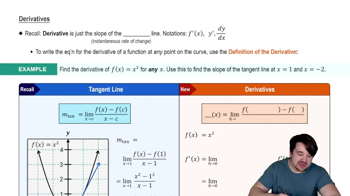
Derivative

The derivative of a function measures how the function's output value changes as its input value changes. It is a fundamental concept in calculus that represents the slope of the tangent line to the curve of the function at any given point. The derivative can be computed using various rules, such as the power rule, product rule, and chain rule.
์ถ”์ฒœ ์˜์ƒ:

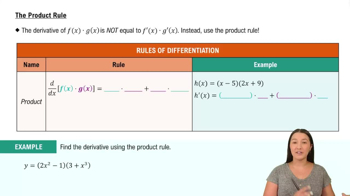
Product Rule

The product rule is a formula used to find the derivative of the product of two functions. It states that if you have two functions, u(x) and v(x), the derivative of their product is given by u'v + uv'. This rule is essential when differentiating functions that are products of simpler functions, as seen in the given function y = xยฒ sinยฒ(2xยฒ).
์ถ”์ฒœ ์˜์ƒ:
05:18
The Product Rule

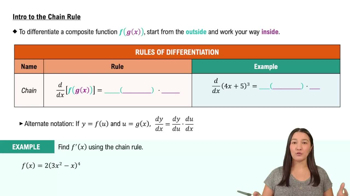
Chain Rule

The chain rule is a technique for differentiating composite functions. If a function y is defined as a composition of two functions, say y = f(g(x)), the chain rule states that the derivative is given by dy/dx = f'(g(x)) * g'(x). This rule is particularly useful when dealing with functions that include nested expressions, such as sinยฒ(2xยฒ) in the given problem.
์ถ”์ฒœ ์˜์ƒ:
05:02
Intro to the Chain Rule