
교과서 질문
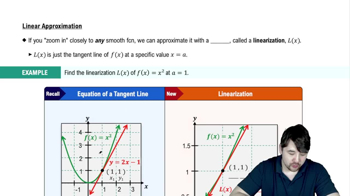
Find the linearizations of
a. tan x at x = -π/4
Graph the curves and linearizations together.
177
views

 검증된 단계별 안내
 07:17
07:17
 05:44
05:44 4:26
4:26Find the linearizations of
a. tan x at x = -π/4
Graph the curves and linearizations together.
The circumference of the equator of a sphere is measured as 10 cm with a possible error of 0.4 cm. This measurement is used to calculate the radius. The radius is then used to calculate the surface area and volume of the sphere. Estimate the percentage errors in the calculated values of
a. the radius.
b. the surface area.
c. the volume.
How accurately should you measure the edge of a cube to be reasonably sure of calculating the cube’s surface area with an error of no more than 2%?
To find the height of a lamppost (see accompanying figure), you stand a 6-ft pole 20 ft from the lamp and measure the length a of its shadow, finding it to be 15 ft, give or take an inch. Calculate the height of the lamppost using the value a = 15 and estimate the possible error in the result.
<IMAGE>
Moving searchlight beam The figure shows a boat 1 km offshore, sweeping the shore with a searchlight. The light turns at a constant rate, dθ/dt = -0.6 rad/sec.
b. How many revolutions per minute is 0.6 rad/sec?
<IMAGE>
Draining a tank Water drains from the conical tank shown in the accompanying figure at the rate of 5 ft³/min.
a. What is the relation between the variables h and r in the figure?
<IMAGE>