

Ch. 3 - Derivatives
Hass - Thomas' Calculus 15th Edition
Hass15th EditionThomas' CalculusISBN: 9780137616077당신이 사용하는 게 아니라요?교과서 변경
3장, 문제 3.5.34a

Find y⁽⁴⁾ = d⁴y/dx⁴ if:
a. y = −2 sin x

검증된 단계별 안내
1
Start by identifying the function y = -2 sin(x). We need to find the fourth derivative of this function with respect to x.
Recall that the derivative of sin(x) is cos(x), and the derivative of cos(x) is -sin(x). These derivatives alternate as you continue differentiating.
Calculate the first derivative: y' = d/dx [-2 sin(x)] = -2 cos(x).
Calculate the second derivative: y'' = d/dx [-2 cos(x)] = 2 sin(x).
Calculate the third derivative: y''' = d/dx [2 sin(x)] = 2 cos(x). Finally, calculate the fourth derivative: y⁽⁴⁾ = d/dx [2 cos(x)] = -2 sin(x).

비슷한 문제에 대한 검증된 영상 답변:

이 영상 해법은 위 문제에 도움이 된다고 튜터들이 추천한 것입니다.
영상 길이:
2m
도움이 되었나요?

주요 개념

질문에 올바르게 답하기 위해 반드시 이해해야 하는 핵심 개념들은 다음과 같습니다.

Higher-Order Derivatives

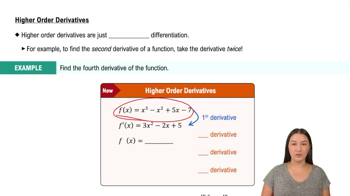
Higher-order derivatives refer to the derivatives of a function taken multiple times. The first derivative represents the rate of change of the function, the second derivative indicates the curvature, and so on. In this case, finding the fourth derivative means applying the differentiation process four times to the function y = -2 sin x.
추천 영상:
02:42
Higher Order Derivatives

Trigonometric Functions

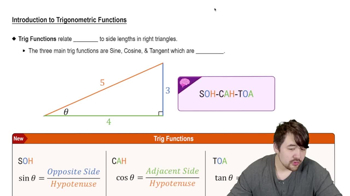
Trigonometric functions, such as sine and cosine, are fundamental in calculus and describe relationships between angles and sides of triangles. The sine function, in particular, oscillates between -1 and 1 and has specific derivatives: the derivative of sin x is cos x, and the derivative of cos x is -sin x. Understanding these properties is essential for differentiating functions involving trigonometric terms.
추천 영상:
가이드 코스
6:04
Introduction to Trigonometric Functions

Chain Rule

The chain rule is a fundamental theorem in calculus used to differentiate composite functions. It states that if a function y is composed of another function u, then the derivative of y with respect to x can be found by multiplying the derivative of y with respect to u by the derivative of u with respect to x. While not directly applied in this specific question, it is crucial for more complex functions involving trigonometric identities.
추천 영상:
05:02
Intro to the Chain Rule
관련 실천
교과서 질문

Interpreting Derivative Values


Growth of yeast cells In a controlled laboratory experiment, yeast cells are grown in an automated cell culture system that counts the number P of cells present at hourly intervals. The number after t hours is shown in the accompanying figure.


" style="" width="250">


a. Explain what is meant by the derivative P'(5). What are its units?

181
views
교과서 질문

If the original 24 m edge length x of a cube decreases at the rate of 5 m/min, when x = 3 m at what rate does the cube’s

a. surface area change?

191
views
교과서 질문

Differentiability and Continuity on an Interval


Each figure in Exercises 45–50 shows the graph of a function over a closed interval D. At what domain points does the function appear to be


a. differentiable?


Give reasons for your answers.


201
views
교과서 질문

The edge x of a cube is measured with an error of at most 0.5%. What is the maximum corresponding percentage error in computing the cube’s


a. surface area?

168
views
교과서 질문

Differentiability and Continuity on an Interval


Each figure in Exercises 45–50 shows the graph of a function over a closed interval D. At what domain points does the function appear to be


a. differentiable?


Give reasons for your answers.


181
views
교과서 질문

Computer Explorations


Use a CAS to perform the following steps in Exercises 55–62.


a. Plot the equation with the implicit plotter of a CAS. Check to see that the given point P satisfies the equation.


xy³ + tan(x + y) = 1, P(π/4, 0)

215
views