Ch. 3 - Derivatives
Hass - Thomas' Calculus 15th Edition
Hass15th EditionThomas' CalculusISBN: 9780137616077당신이 사용하는 게 아니라요?교과서 변경
3장, 문제 3.9.4

Finding Linearizations


In Exercises 1–5, find the linearization L(x) of f(x) at x = a.


f(x) = ∛x, a = −8

검증된 단계별 안내
1
Identify the function f(x) = ∛x and the point of interest x = a = -8.
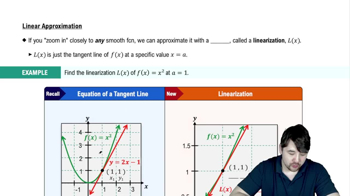
Recall the formula for the linearization of a function at a point: L(x) = f(a) + f'(a)(x - a).
Calculate f(a) by substituting a = -8 into the function: f(-8) = ∛(-8).
Find the derivative f'(x) of the function f(x) = ∛x. Use the power rule for derivatives: f(x) = x^(1/3) implies f'(x) = (1/3)x^(-2/3).
Evaluate the derivative at the point a = -8: f'(-8) = (1/3)(-8)^(-2/3). Substitute f(a) and f'(a) into the linearization formula to find L(x).

비슷한 문제에 대한 검증된 영상 답변:

이 영상 해법은 위 문제에 도움이 된다고 튜터들이 추천한 것입니다.
영상 길이:
2m
도움이 되었나요?

주요 개념

질문에 올바르게 답하기 위해 반드시 이해해야 하는 핵심 개념들은 다음과 같습니다.

Linearization

Linearization is the process of approximating a function near a given point using the tangent line at that point. The linearization of a function f(x) at x = a is given by L(x) = f(a) + f'(a)(x - a). This provides a simple linear model that approximates the function's behavior close to x = a.
추천 영상:

Derivative

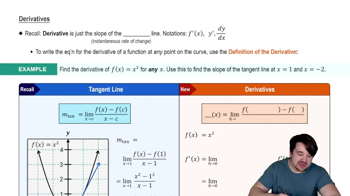
The derivative of a function, denoted as f'(x), represents the rate at which the function's value changes with respect to changes in x. It is the slope of the tangent line to the function at any given point. For linearization, the derivative at x = a, f'(a), is crucial as it determines the slope of the linear approximation.
추천 영상:

Cube Root Function

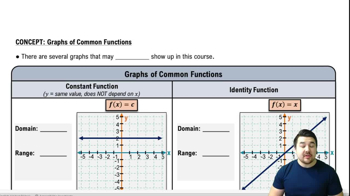
The cube root function, f(x) = ∛x, is a type of root function where the output is the number that, when cubed, gives x. Understanding its behavior, especially around specific points like x = -8, is essential for calculating derivatives and linearizations. The function is continuous and differentiable for all real numbers, which facilitates finding its linear approximation.
추천 영상:
가이드 코스
5:57
Graphs of Common Functions