Ch. 3 - Derivatives
Hass - Thomas' Calculus 15th Edition
Hass15th EditionThomas' CalculusISBN: 9780137616077당신이 사용하는 게 아니라요?교과서 변경
3장, 문제 3.6.86b

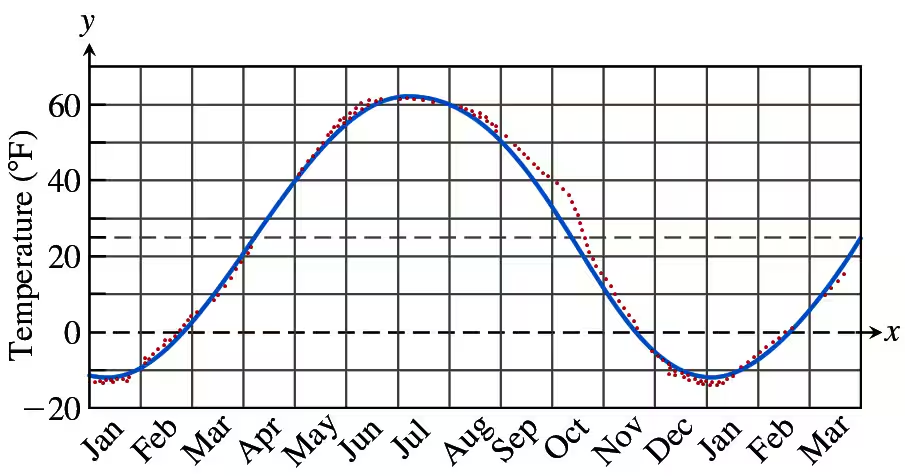
Temperatures in Fairbanks, Alaska The graph in the accompanying figure shows the average Fahrenheit temperature in Fairbanks, Alaska, during a typical 365-day year. The equation that approximates the temperature on day x is


y = 37 sin[(2π/365)(x − 101)] + 25


and is graphed in the accompanying figure.


b. About how many degrees per day is the temperature increasing when it is increasing at its fastest?


<IMAGE>

검증된 단계별 안내
1
Step 1: To determine the rate at which the temperature is increasing at its fastest, we need to find the derivative of the given temperature function y = 37 sin[(2π/365)(x − 101)] + 25. The derivative represents the rate of change of temperature with respect to time (x).
Step 2: Differentiate the function y with respect to x. Using the chain rule, the derivative of y = 37 sin[(2π/365)(x − 101)] + 25 is given by dy/dx = 37 * cos[(2π/365)(x − 101)] * (2π/365). The constant 25 disappears because its derivative is zero.
Step 3: Simplify the derivative expression. The derivative becomes dy/dx = (74π/365) * cos[(2π/365)(x − 101)]. This represents the rate of change of temperature at any given day x.
Step 4: To find the maximum rate of increase, observe that the cosine function achieves its maximum value of 1. Substitute cos[(2π/365)(x − 101)] = 1 into the derivative expression. This gives the maximum rate of change as dy/dx = (74π/365).
Step 5: Interpret the result. The maximum rate of temperature increase occurs when the cosine term equals 1, which corresponds to the steepest part of the graph. The value of (74π/365) represents the maximum degrees per day the temperature is increasing.

비슷한 문제에 대한 검증된 영상 답변:

이 영상 해법은 위 문제에 도움이 된다고 튜터들이 추천한 것입니다.
영상 길이:
4m

주요 개념

질문에 올바르게 답하기 위해 반드시 이해해야 하는 핵심 개념들은 다음과 같습니다.

Derivative of a Function

The derivative of a function represents the rate at which the function's value changes with respect to its input. In the context of the temperature function, the derivative will indicate how quickly the temperature is increasing or decreasing on a given day. Calculating the derivative of the given sinusoidal function will help determine the rate of temperature change.
추천 영상:
06:30
Derivatives of Other Trig Functions

Sinusoidal Functions

Sinusoidal functions, such as sine and cosine, are periodic functions that oscillate between a maximum and minimum value. The given temperature function is a sine function, which models the cyclical nature of temperature changes over a year. Understanding the properties of sinusoidal functions, including amplitude, period, and phase shift, is crucial for analyzing the temperature pattern in Fairbanks.
추천 영상:
가이드 코스
06:21
Properties of Functions

Critical Points and Maximum Rate of Change

Critical points occur where the derivative of a function is zero or undefined, indicating potential maxima, minima, or points of inflection. To find when the temperature increases at its fastest, we need to identify the point where the derivative reaches its maximum positive value. This involves analyzing the derivative to find where the rate of change is greatest, which corresponds to the steepest slope on the graph.
추천 영상:
04:50
Critical Points