
Ch. 3 - Derivatives
Hass - Thomas' Calculus 15th Edition
Hass15th EditionThomas' CalculusISBN: 9780137616077당신이 사용하는 게 아니라요?교과서 변경
3장, 문제 3.4.15a

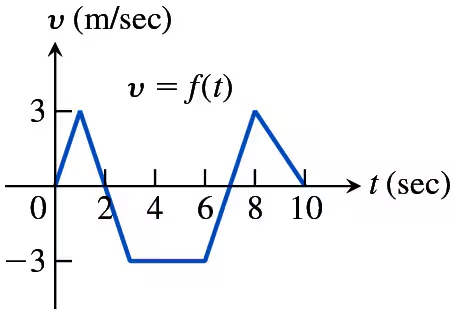
The accompanying figure shows the velocity v = ds/dt = f(t) (m/sec) of a body moving along a coordinate line.


Graph showing velocity over time, with v in m/sec on the vertical axis and t in sec on the horizontal axis, indicating direction changes.
a. When does the body reverse direction?

검증된 단계별 안내
1
To determine when the body reverses direction, we need to find when the velocity changes sign. This occurs when the velocity function v(t) crosses the horizontal axis (v = 0).
Examine the graph of v(t) to identify the points where the curve crosses the t-axis. These points are where the velocity is zero.
From the graph, observe that the velocity crosses the t-axis at approximately t = 2 seconds, t = 6 seconds, and t = 9 seconds.
At these points, the velocity changes from positive to negative or from negative to positive, indicating a reversal in direction.
Thus, the body reverses direction at t = 2 seconds, t = 6 seconds, and t = 9 seconds.

비슷한 문제에 대한 검증된 영상 답변:

이 영상 해법은 위 문제에 도움이 된다고 튜터들이 추천한 것입니다.
영상 길이:
2m

주요 개념

질문에 올바르게 답하기 위해 반드시 이해해야 하는 핵심 개념들은 다음과 같습니다.

Velocity and Direction

Velocity is a vector quantity that indicates the rate of change of position with respect to time. When analyzing motion, the sign of the velocity determines the direction of movement. A positive velocity indicates motion in one direction, while a negative velocity indicates motion in the opposite direction. Understanding how velocity changes over time is crucial for determining when an object reverses its direction.
추천 영상:
가이드 코스
06:29
Derivatives Applied To Velocity

Critical Points and Zeroes

Critical points occur where the velocity function is zero or undefined. These points are essential for analyzing motion because they indicate potential changes in direction. In the context of the graph, when the velocity crosses the time axis (where v = 0), it signifies that the body may be reversing its direction. Identifying these zeroes helps in understanding the overall motion of the object.
추천 영상:
04:50
Critical Points

Graph Interpretation

Interpreting graphs is a fundamental skill in calculus, particularly when analyzing functions like velocity. The graph of velocity versus time provides visual insights into how the velocity changes over time. By examining the graph, one can identify intervals of positive and negative velocity, as well as points where the velocity is zero, which are critical for determining when the body reverses direction.
추천 영상:
가이드 코스
06:15
Graphing The Derivative