Ch. 3 - Derivatives
Hass - Thomas' Calculus 15th Edition
Hass15th EditionThomas' CalculusISBN: 9780137616077당신이 사용하는 게 아니라요?교과서 변경
3장, 문제 2.9.46b

The edge x of a cube is measured with an error of at most 0.5%. What is the maximum corresponding percentage error in computing the cube’s


b. volume?

검증된 단계별 안내
1
First, understand that the volume V of a cube with edge length x is given by the formula: V=x3.
To find the maximum percentage error in the volume, we need to use the concept of differentials. The differential of the volume, dV, can be expressed in terms of the differential of x, dx, as: dV=Vxdx.
Calculate the derivative of the volume with respect to x: Vx=x3x=3x2.
Substitute the derivative into the differential equation: dV=3x2dx. The relative error in x is given as 0.5%, which means dxx=0.005.
The relative error in volume is then: dVV=3x2dxx3=3dxx. Multiply this by 100 to convert to a percentage error: 3×0.5=1.5 percent.

비슷한 문제에 대한 검증된 영상 답변:

이 영상 해법은 위 문제에 도움이 된다고 튜터들이 추천한 것입니다.
영상 길이:
3m
도움이 되었나요?

주요 개념

질문에 올바르게 답하기 위해 반드시 이해해야 하는 핵심 개념들은 다음과 같습니다.

Differential Error Analysis

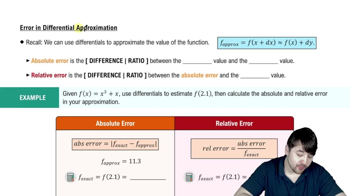
Differential error analysis involves using calculus to approximate the change in a function's output based on small changes in its input. For a function f(x), the differential df represents the approximate change in f due to a small change dx in x. This concept is crucial for understanding how measurement errors propagate in calculations, such as finding the volume of a cube.
추천 영상:
가이드 코스
04:57
Determining Error and Relative Error

Volume of a Cube

The volume of a cube is calculated using the formula V = x^3, where x is the length of an edge. Understanding this formula is essential because it shows how the volume depends on the cube's edge length. Any error in measuring x will affect the calculated volume, and this relationship is key to determining the percentage error in the volume.
추천 영상:
04:48
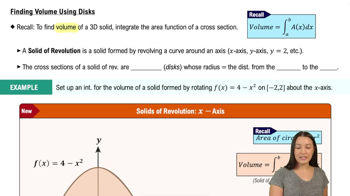
Finding Volume Using Disks

Percentage Error Calculation

Percentage error quantifies the relative error in a measurement as a percentage of the true value. It is calculated by dividing the absolute error by the true value and multiplying by 100. In the context of the cube's volume, understanding how to compute percentage error helps in assessing the impact of measurement inaccuracies on the calculated volume.
추천 영상:
가이드 코스
04:57
Determining Error and Relative Error