Ch. 3 - Derivatives
Hass - Thomas' Calculus 15th Edition
Hass15th EditionThomas' CalculusISBN: 9780137616077당신이 사용하는 게 아니라요?교과서 변경
3장, 문제 3.5.49

Theory and Examples


The equations in Exercises 49 and 50 give the position s = f(t) of a body moving on a coordinate line (s in meters, t in seconds). Find the body’s velocity, speed, acceleration, and jerk at time t = π/4 sec.


s = 2 − 2 sin t

검증된 단계별 안내
1
To find the body's velocity at time \( t = \frac{\pi}{4} \), we need to take the first derivative of the position function \( s(t) = 2 - 2 \sin t \) with respect to \( t \). The derivative of \( -2 \sin t \) is \( -2 \cos t \). Therefore, the velocity function \( v(t) \) is \( v(t) = -2 \cos t \).
Next, to find the speed at \( t = \frac{\pi}{4} \), we take the absolute value of the velocity function at that time. Speed is the magnitude of velocity, so \( \text{speed} = |v(t)| = |-2 \cos(\frac{\pi}{4})| \).
To find the acceleration at \( t = \frac{\pi}{4} \), we take the derivative of the velocity function \( v(t) = -2 \cos t \). The derivative of \( -2 \cos t \) is \( 2 \sin t \). Thus, the acceleration function \( a(t) \) is \( a(t) = 2 \sin t \).
For the jerk, which is the derivative of acceleration, we differentiate the acceleration function \( a(t) = 2 \sin t \). The derivative of \( 2 \sin t \) is \( 2 \cos t \). Therefore, the jerk function \( j(t) \) is \( j(t) = 2 \cos t \).
Finally, evaluate each of these functions at \( t = \frac{\pi}{4} \): \( v(\frac{\pi}{4}) = -2 \cos(\frac{\pi}{4}) \), \( \text{speed} = |-2 \cos(\frac{\pi}{4})| \), \( a(\frac{\pi}{4}) = 2 \sin(\frac{\pi}{4}) \), and \( j(\frac{\pi}{4}) = 2 \cos(\frac{\pi}{4}) \).

비슷한 문제에 대한 검증된 영상 답변:

이 영상 해법은 위 문제에 도움이 된다고 튜터들이 추천한 것입니다.
영상 길이:
5m
도움이 되었나요?

주요 개념

질문에 올바르게 답하기 위해 반드시 이해해야 하는 핵심 개념들은 다음과 같습니다.

Differentiation

Differentiation is the process of finding the derivative of a function, which represents the rate of change of the function with respect to its variable. In the context of motion, the first derivative of the position function s = f(t) with respect to time t gives the velocity of the body. This is crucial for determining how the position changes over time.
추천 영상:
가이드 코스
05:53
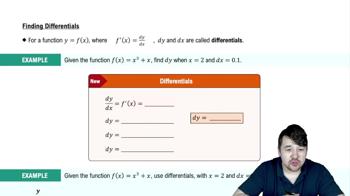
Finding Differentials

Velocity and Speed

Velocity is a vector quantity that describes the rate of change of position with respect to time, including direction. It is obtained by differentiating the position function. Speed, on the other hand, is the magnitude of velocity and is a scalar quantity, representing how fast the body is moving regardless of direction. Calculating both helps understand the motion dynamics at a specific time.
추천 영상:
가이드 코스
06:29
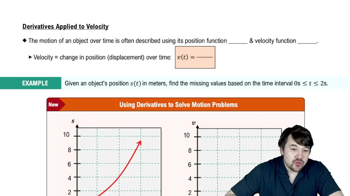
Derivatives Applied To Velocity

Higher Order Derivatives

Higher order derivatives involve differentiating a function multiple times. The second derivative of the position function gives acceleration, indicating how velocity changes over time. The third derivative, known as jerk, describes the rate of change of acceleration. These derivatives provide deeper insights into the motion characteristics, such as how smoothly or abruptly the body accelerates.
추천 영상:
02:42
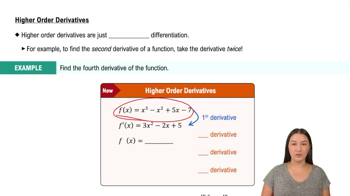
Higher Order Derivatives