
Ch. 3 - Derivatives
Hass - Thomas' Calculus 15th Edition
Hass15th EditionThomas' CalculusISBN: 9780137616077당신이 사용하는 게 아니라요?교과서 변경
3장, 문제 3.9.14a

Use the linear approximation (1 + x)ᵏ ≈ 1 + kx to find an approximation for the function f(x) for values of x near zero.


a. f(x) = (1 − x)⁶

검증된 단계별 안내
1
Identify the function f(x) = (1 - x)⁶ and recognize that it is in the form of (1 + x)ᵏ with k = 6 and x replaced by -x.
Apply the linear approximation formula (1 + x)ᵏ ≈ 1 + kx to the function. Here, substitute x with -x and k with 6.
The linear approximation becomes: (1 - x)⁶ ≈ 1 + 6(-x).
Simplify the expression: 1 + 6(-x) becomes 1 - 6x.
Thus, the linear approximation for f(x) = (1 - x)⁶ near x = 0 is f(x) ≈ 1 - 6x.

비슷한 문제에 대한 검증된 영상 답변:

이 영상 해법은 위 문제에 도움이 된다고 튜터들이 추천한 것입니다.
영상 길이:
1m
도움이 되었나요?

주요 개념

질문에 올바르게 답하기 위해 반드시 이해해야 하는 핵심 개념들은 다음과 같습니다.

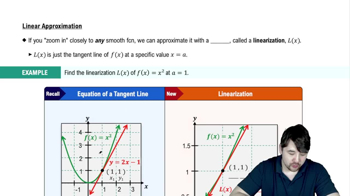
Linear Approximation

Linear approximation is a method used to estimate the value of a function near a given point using the tangent line at that point. For a function f(x), the linear approximation at x = a is given by f(a) + f'(a)(x - a). This technique is particularly useful for simplifying complex functions near a specific point, often x = 0.
추천 영상:

Binomial Expansion

The binomial expansion is a way of expressing powers of binomials, such as (1 + x)ᵏ, as a series. For small values of x, the expansion can be approximated by the first few terms, often just 1 + kx for linear approximation. This simplification is useful for estimating the behavior of functions like (1 - x)⁶ near x = 0.
추천 영상:
07:01
Integrals Involving Natural Logs: Substitution

Function Behavior Near Zero

Understanding the behavior of functions near zero involves analyzing how the function changes as x approaches zero. This often involves using approximations or expansions to simplify the function, making it easier to evaluate or estimate. For f(x) = (1 - x)⁶, using linear approximation helps predict its value when x is close to zero.
추천 영상:
6:37
Zero and Negative Rules