Ch. 4 - Applications of Derivatives
Hass - Thomas' Calculus 15th Edition
Hass15th EditionThomas' CalculusISBN: 9780137616077당신이 사용하는 게 아니라요?교과서 변경
4장, 문제 4.4.105c

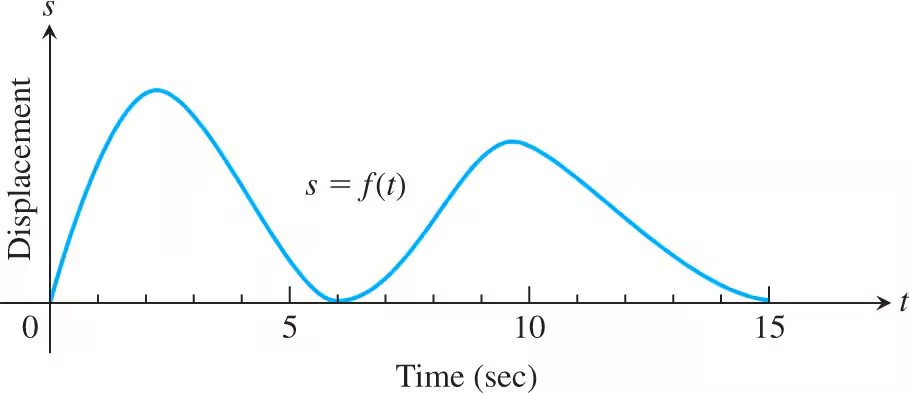
105. Motion Along a Line The graphs in Exercises 105 and 106 show the position s=f(t) of an object moving up and down on a coordinate line. At approximately what times is the (c) Acceleration equal to zero?
Graph showing displacement over time, with a blue curve representing the function s=f(t) on a coordinate plane.

검증된 단계별 안내
1
To find when the acceleration is zero, we need to understand that acceleration is the second derivative of the position function s=f(t) with respect to time t.
First, identify the velocity function v(t) by taking the first derivative of the position function s=f(t). The velocity is zero at the peaks and troughs of the position graph.
Next, find the acceleration function a(t) by taking the derivative of the velocity function v(t). This is the second derivative of the position function.
The acceleration is zero when the second derivative of the position function is zero. This typically occurs at inflection points of the position graph, where the concavity changes.
Examine the graph to identify the points where the concavity changes. These are the points where the acceleration is zero. Look for points where the curve changes from concave up to concave down or vice versa.

비슷한 문제에 대한 검증된 영상 답변:

이 영상 해법은 위 문제에 도움이 된다고 튜터들이 추천한 것입니다.
영상 길이:
2m

주요 개념

질문에 올바르게 답하기 위해 반드시 이해해야 하는 핵심 개념들은 다음과 같습니다.

Position Function

The position function, denoted as s = f(t), describes the location of an object along a coordinate line at any given time t. It is a continuous function that can represent various types of motion, such as linear or oscillatory. Understanding this function is crucial for analyzing the object's movement and determining its velocity and acceleration.
추천 영상:
가이드 코스
5:20
Relations and Functions

Velocity

Velocity is the rate of change of the position function with respect to time, mathematically expressed as v(t) = f'(t). It indicates how fast and in which direction the object is moving. When the velocity is zero, it signifies that the object is momentarily at rest, which is essential for identifying points where acceleration may also be zero.
추천 영상:
가이드 코스
06:29
Derivatives Applied To Velocity

Acceleration

Acceleration is the rate of change of velocity with respect to time, represented as a(t) = v'(t) or a(t) = f''(t). It indicates how quickly the velocity of an object is changing. When acceleration equals zero, it implies that the object is not speeding up or slowing down at that moment, which can occur at points of inflection on the position graph.
추천 영상:
가이드 코스
06:15
Derivatives Applied To Acceleration