

Ch. 4 - Applications of Derivatives
Hass - Thomas' Calculus 15th Edition
Hass15th EditionThomas' CalculusISBN: 9780137616077당신이 사용하는 게 아니라요?교과서 변경
4장, 문제 4.4.107

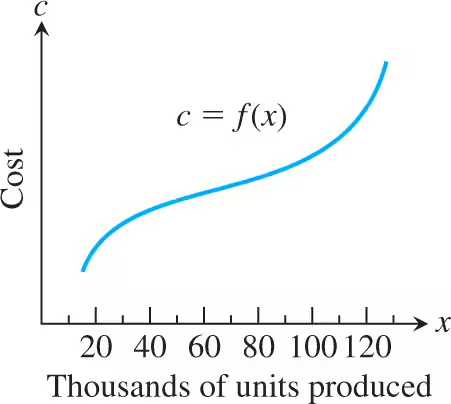
107. Marginal cost The accompanying graph shows the hypothetical cost c=f(x) of manufacturing x items. At approximately what production level does the marginal cost change from decreasing to increasing?
Graph showing cost versus production level, illustrating the marginal cost's transition from decreasing to increasing.

검증된 단계별 안내
1
Step 1: Understand the concept of marginal cost. Marginal cost is the derivative of the cost function c=f(x) with respect to the number of items produced, x. It represents the rate of change of cost as production increases.
Step 2: Analyze the graph provided. The graph shows the cost function c=f(x) as a curve. To determine where the marginal cost changes from decreasing to increasing, we need to identify the point where the slope of the tangent to the curve transitions from decreasing to increasing.
Step 3: Look for the inflection point on the graph. An inflection point is where the curvature of the graph changes, which corresponds to the second derivative of the cost function changing sign. This is the point where the marginal cost transitions from decreasing to increasing.
Step 4: Estimate the production level at the inflection point. From the graph, observe the curve's behavior and approximate the x-value (production level) where the slope of the tangent stops decreasing and starts increasing. This appears to be around x=60 thousand units.
Step 5: Conclude that the marginal cost changes from decreasing to increasing at approximately x=60 thousand units. This is based on the visual analysis of the graph and the concept of inflection points.

비슷한 문제에 대한 검증된 영상 답변:

이 영상 해법은 위 문제에 도움이 된다고 튜터들이 추천한 것입니다.
영상 길이:
2m

주요 개념

질문에 올바르게 답하기 위해 반드시 이해해야 하는 핵심 개념들은 다음과 같습니다.

Marginal Cost

Marginal cost refers to the additional cost incurred when producing one more unit of a good or service. It is derived from the cost function, c = f(x), by calculating the derivative, f'(x). Understanding where marginal cost increases or decreases helps businesses make informed production decisions.
추천 영상:
07:32
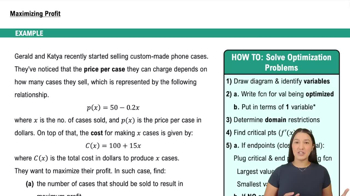
Example 3: Maximizing Profit

Cost Function

The cost function, represented as c = f(x), describes the total cost of producing x units of a product. It typically reflects fixed and variable costs and can be analyzed to determine how costs change with varying production levels. The shape of this function is crucial for identifying points of marginal cost change.
추천 영상:
가이드 코스
06:21
Properties of Functions

Inflection Point

An inflection point on a graph is where the curvature changes, indicating a transition in the behavior of the function. In the context of marginal cost, it marks the production level where the marginal cost shifts from decreasing to increasing, which is essential for optimizing production efficiency and cost management.
추천 영상:
04:50
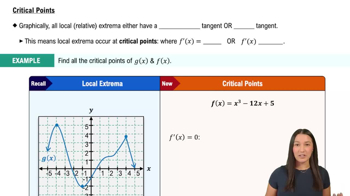
Critical Points
관련 실천
교과서 질문

Identifying Extrema


In Exercises 19–40:


a. Find the open intervals on which the function is increasing and those on which it is decreasing.


b. Identify the function’s local extreme values, if any, saying where they occur.


f(x) = x − 6√(x − 1)

152
views
교과서 질문

Identifying Extrema


In Exercises 15–18:


a. Find the open intervals on which the function is increasing and those on which it is decreasing.


b. Identify the function’s local and absolute extreme values, if any, saying where they occur.


206
views
교과서 질문

26. Constructing cylinders Compare the answers to the following two construction problems.

a. A rectangular sheet of perimeter 36 cm and dimensions x cm by y cm is to be rolled into a cylinder as shown in part (a) of the figure. What values of x and y give the largest volume?

b. The same sheet is to be revolved about one of the sides of length y to sweep out the cylinder as shown in part (b) of the figure. What values of x and y give the largest volume?

" style="" width="350">

189
views
교과서 질문

Theory and Examples


In Exercises 53 and 54, show that the function has neither an absolute minimum nor an absolute maximum on its natural domain.


y = x¹¹ + x³ + x − 5

206
views
교과서 질문

Checking the Mean Value Theorem


Find the value or values of c that satisfy the equation (f(b) − f(a)) / (b − a) = f′(c) in the conclusion of the Mean Value Theorem for the functions and intervals in Exercises 1–6.


f(x) =√(x − 1), [1, 3]

259
views
교과서 질문

Applications


A marathoner ran the 26.2-mi New York City Marathon in 2.2 hours. Show that at least twice the marathoner was running at exactly 11 mph, assuming the initial and final speeds are zero.

213
views