Ch. 4 - Applications of Derivatives
Hass - Thomas' Calculus 15th Edition
Hass15th EditionThomas' CalculusISBN: 9780137616077당신이 사용하는 게 아니라요?교과서 변경
4장, 문제 4.4.114b

114. Parabolas
b. When is the parabola concave up? Concave down?

검증된 단계별 안내
1
To determine when a parabola is concave up or concave down, we need to look at the second derivative of its equation. A parabola is typically given by the quadratic function \( f(x) = ax^2 + bx + c \).
The second derivative of the function \( f(x) = ax^2 + bx + c \) is \( f''(x) = 2a \). This is a constant value, meaning it does not depend on \( x \).
A parabola is concave up when the second derivative is positive. Therefore, if \( 2a > 0 \), the parabola is concave up. This simplifies to \( a > 0 \).
Conversely, a parabola is concave down when the second derivative is negative. Therefore, if \( 2a < 0 \), the parabola is concave down. This simplifies to \( a < 0 \).
In summary, the concavity of a parabola is determined by the sign of the coefficient \( a \) in the quadratic function. If \( a > 0 \), the parabola is concave up, and if \( a < 0 \), it is concave down.

비슷한 문제에 대한 검증된 영상 답변:

이 영상 해법은 위 문제에 도움이 된다고 튜터들이 추천한 것입니다.
영상 길이:
1m
도움이 되었나요?

주요 개념

질문에 올바르게 답하기 위해 반드시 이해해야 하는 핵심 개념들은 다음과 같습니다.

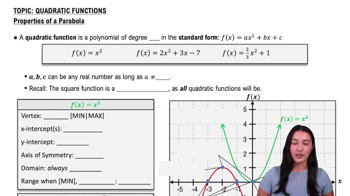
Parabola

A parabola is a U-shaped curve that can open upwards or downwards, defined by a quadratic function of the form y = ax^2 + bx + c. The direction in which the parabola opens is determined by the sign of the coefficient 'a'. If 'a' is positive, the parabola opens upwards; if 'a' is negative, it opens downwards.
추천 영상:
7:42
Properties of Parabolas

Concavity

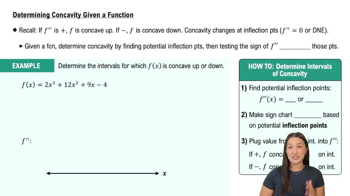
Concavity refers to the direction in which a curve bends. A function is concave up if it bends upwards like a cup, and concave down if it bends downwards like a cap. For a parabola, concavity is determined by the sign of the leading coefficient 'a' in the quadratic equation: positive 'a' indicates concave up, while negative 'a' indicates concave down.
추천 영상:
05:59
Determining Concavity Given a Function

Second Derivative Test

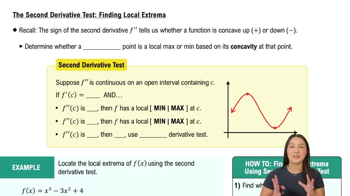
The second derivative test is used to determine the concavity of a function. For a quadratic function y = ax^2 + bx + c, the second derivative is a constant, 2a. If 2a > 0, the function is concave up, and if 2a < 0, it is concave down. This test helps in identifying the nature of the parabola's curvature.
추천 영상:
06:02
The Second Derivative Test: Finding Local Extrema
관련 실천
교과서 질문

Checking Antiderivative Formulas


Right, or wrong? Say which for each formula and give a brief reason for each answer.


∫xsinx dx = -x cos x + C

35
views

교과서 질문

[Technology Exercise] 16. Designing a box with a lid A piece of cardboard measures 10 in. by 15 in. Two equal squares are removed from the corners of a 10-in. side as shown in the figure. Two equal rectangles are removed from the other corners so that the tabs can be folded to form a rectangular box with lid.

" style="" width="335">

b. Find the domain of V for the problem situation and graph V over this domain.

222
views
교과서 질문

Identifying Extrema


In Exercises 63 and 64, the graph of f' is given. Assume that f has domain (-2, 2).


" style="max-width: 100%; white-space-collapse: preserve;" width="190">


b. Either use the graph to determine which intervals f is positive on and which intervals f is negative on, or explain why this information cannot be determined from the graph.

231
views
교과서 질문

Theory and Examples


In Exercises 51 and 52, give reasons for your answers.


Let f(x) = |x³ − 9x|.


b. Does f'(3) exist?

162
views
교과서 질문

Analyzing Functions from Derivatives


Answer the following questions about the functions whose derivatives are given in Exercises 1–14:


b. On what open intervals is f increasing or decreasing?


f′(x) = (x − 1)(x + 2)(x − 3)

209
views
교과서 질문

Finding Antiderivatives

In Exercises 1–16, find an antiderivative for each function. Do as many as you can mentally. Check your answers by differentiation.

x⁷

28
views