Ch. 4 - Applications of Derivatives
Hass - Thomas' Calculus 15th Edition
Hass15th EditionThomas' CalculusISBN: 9780137616077당신이 사용하는 게 아니라요?교과서 변경
4장, 문제 4.4.93

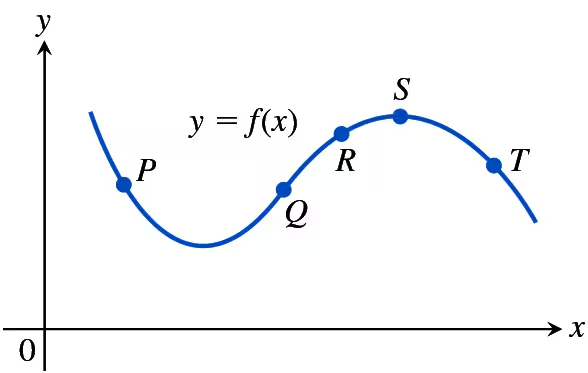
93. The accompanying figure shows a portion of the graph of a twice-differentiable function y=f(x). At each of the five labeled points, classify y' and \(\y\)'' as positive, negative, or zero.
<IMAGE>

검증된 단계별 안내
1
Step 1: Understand the problem. The graph represents a twice-differentiable function y = f(x). At each labeled point (P, Q, R, S, T), we need to classify the first derivative (y') and the second derivative (y'') as positive, negative, or zero based on the behavior of the graph.
Step 2: Analyze point P. At P, the graph is decreasing (sloping downward), so y' < 0. The graph is concave down (curving downward), so y'' < 0.
Step 3: Analyze point Q. At Q, the graph is at a local minimum, meaning the slope is zero (y' = 0). The graph transitions from concave down to concave up, so y'' > 0.
Step 4: Analyze point R. At R, the graph is increasing (sloping upward), so y' > 0. The graph is concave up (curving upward), so y'' > 0.
Step 5: Analyze point S. At S, the graph is at a local maximum, meaning the slope is zero (y' = 0). The graph transitions from concave up to concave down, so y'' < 0.

비슷한 문제에 대한 검증된 영상 답변:

이 영상 해법은 위 문제에 도움이 된다고 튜터들이 추천한 것입니다.
영상 길이:
2m

주요 개념

질문에 올바르게 답하기 위해 반드시 이해해야 하는 핵심 개념들은 다음과 같습니다.

First Derivative (y')

The first derivative of a function, y', represents the slope of the tangent line to the graph at any given point. It indicates the rate of change of the function. If y' is positive, the function is increasing; if y' is negative, the function is decreasing; and if y' is zero, the function has a horizontal tangent, indicating a potential local maximum or minimum.
추천 영상:
07:09
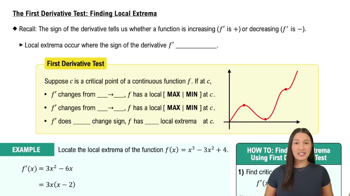
The First Derivative Test: Finding Local Extrema

Second Derivative (y'')

The second derivative, y'', provides information about the concavity of the function. If y'' is positive, the graph is concave up, resembling a 'U' shape, indicating that the slope of the tangent line is increasing. If y'' is negative, the graph is concave down, resembling an 'n' shape, indicating that the slope of the tangent line is decreasing. A zero value for y'' may indicate an inflection point where the concavity changes.
추천 영상:
06:02
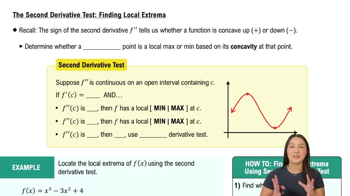
The Second Derivative Test: Finding Local Extrema

Critical Points and Inflection Points

Critical points occur where the first derivative y' is zero or undefined, often corresponding to local maxima or minima. Inflection points occur where the second derivative y'' is zero or changes sign, indicating a change in concavity. Analyzing these points helps in understanding the behavior of the function and its graph, such as identifying peaks, troughs, and points of curvature change.
추천 영상:
04:50
Critical Points