Ch. 4 - Applications of Derivatives
Hass - Thomas' Calculus 15th Edition
Hass15th EditionThomas' CalculusISBN: 9780137616077당신이 사용하는 게 아니라요?교과서 변경
4장, 문제 4.3.1c

Analyzing Functions from Derivatives


Answer the following questions about the functions whose derivatives are given in Exercises 1–14:


c. At what points, if any, does f assume local maximum or minimum values?


f′(x) = x(x − 1)

검증된 단계별 안내
1
To find the points where the function f assumes local maximum or minimum values, we need to identify the critical points. Critical points occur where the derivative f'(x) is zero or undefined. Start by setting the derivative equal to zero: f'(x) = x(x - 1) = 0.
Solve the equation x(x - 1) = 0 to find the critical points. This equation can be factored into two parts: x = 0 and x - 1 = 0. Solving these gives the critical points x = 0 and x = 1.
Next, determine whether each critical point is a local maximum, minimum, or neither by using the first derivative test. This involves analyzing the sign of f'(x) around each critical point.
Choose test points in the intervals determined by the critical points: for example, pick a point less than 0, between 0 and 1, and greater than 1. Evaluate the sign of f'(x) at these test points to determine the behavior of f(x).
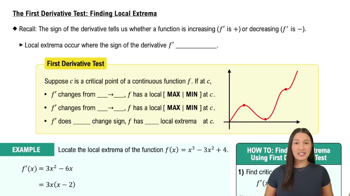
If f'(x) changes from positive to negative at a critical point, f has a local maximum there. If f'(x) changes from negative to positive, f has a local minimum. If there is no sign change, the critical point is neither a maximum nor a minimum.

비슷한 문제에 대한 검증된 영상 답변:

이 영상 해법은 위 문제에 도움이 된다고 튜터들이 추천한 것입니다.
영상 길이:
3m
도움이 되었나요?

주요 개념

질문에 올바르게 답하기 위해 반드시 이해해야 하는 핵심 개념들은 다음과 같습니다.

Critical Points

Critical points of a function occur where its derivative is zero or undefined. These points are potential locations for local maxima or minima. To find them, set the derivative equal to zero and solve for x. In this case, solve f′(x) = x(x − 1) = 0 to find the critical points.
추천 영상:
04:50
Critical Points

First Derivative Test

The First Derivative Test helps determine whether a critical point is a local maximum, minimum, or neither. By analyzing the sign changes of the derivative around the critical points, one can infer the behavior of the function. If f′ changes from positive to negative, the point is a local maximum; if it changes from negative to positive, it's a local minimum.
추천 영상:
07:09
The First Derivative Test: Finding Local Extrema

Local Maximum and Minimum

A function has a local maximum at a point if the function value at that point is greater than at nearby points. Conversely, a local minimum occurs if the function value is less than at nearby points. Identifying these points involves analyzing the critical points and using tests like the First Derivative Test to confirm the nature of each point.
추천 영상:
06:02
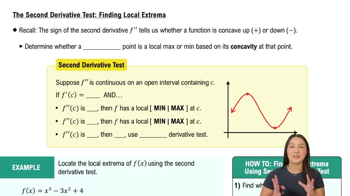
The Second Derivative Test: Finding Local Extrema