Ch. 4 - Applications of Derivatives
Hass - Thomas' Calculus 15th Edition
Hass15th EditionThomas' CalculusISBN: 9780137616077당신이 사용하는 게 아니라요?교과서 변경
4장, 문제 4.3.5a

Analyzing Functions from Derivatives


Answer the following questions about the functions whose derivatives are given in Exercises 1–14:


a. What are the critical points of f?


f′(x) = (x − 1)(x + 2)(x − 3)

검증된 단계별 안내
1
To find the critical points of the function f, we need to determine where the derivative f'(x) is equal to zero or undefined. Since f'(x) = (x - 1)(x + 2)(x - 3), we focus on where this expression equals zero.
Set f'(x) = 0: (x - 1)(x + 2)(x - 3) = 0. This equation is satisfied when any of the factors is zero.
Solve each factor for x: x - 1 = 0, x + 2 = 0, and x - 3 = 0. This gives us the potential critical points.
The solutions to these equations are x = 1, x = -2, and x = 3. These are the critical points of the function f.
Verify that these points are indeed critical points by ensuring that f'(x) changes sign around these values, indicating a change in the behavior of the function f.

비슷한 문제에 대한 검증된 영상 답변:

이 영상 해법은 위 문제에 도움이 된다고 튜터들이 추천한 것입니다.
영상 길이:
1m
도움이 되었나요?

주요 개념

질문에 올바르게 답하기 위해 반드시 이해해야 하는 핵심 개념들은 다음과 같습니다.

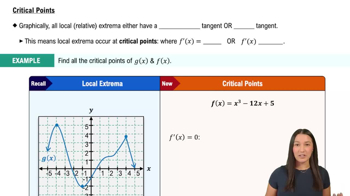
Critical Points

Critical points of a function occur where its derivative is zero or undefined. These points are significant because they can indicate local maxima, minima, or points of inflection. To find critical points, set the derivative equal to zero and solve for the variable, which in this case involves solving f′(x) = (x − 1)(x + 2)(x − 3) = 0.
추천 영상:
04:50
Critical Points

Factoring Polynomials

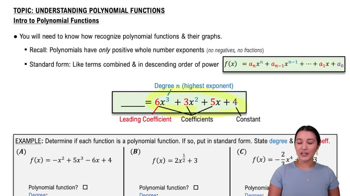
Factoring polynomials is a method used to simplify expressions and solve equations. It involves expressing a polynomial as a product of its factors. For the derivative f′(x) = (x − 1)(x + 2)(x − 3), the factors are already given, making it straightforward to find the roots by setting each factor equal to zero: x = 1, x = -2, and x = 3.
추천 영상:
6:04
Introduction to Polynomial Functions

Roots of Equations

The roots of an equation are the values of the variable that satisfy the equation, making it equal to zero. In the context of derivatives, finding the roots of f′(x) helps identify the critical points of the function f(x). For f′(x) = (x − 1)(x + 2)(x − 3), the roots are x = 1, x = -2, and x = 3, which are the critical points of the function.
추천 영상:
5:02
Solving Logarithmic Equations
관련 실천
교과서 질문

Identifying Extrema


In Exercises 41–52:


a. Identify the function’s local extreme values in the given domain, and say where they occur.


g(x) = −x² − 6x − 9,−4 ≤ x < ∞

160
views

교과서 질문

53. Distance between two ships At noon, ship A was 12 nautical miles due north of ship B. Ship A was sailing south at 12 knots (nautical miles per hour; a nautical mile is 2000 yd) and continued to do so all day. Ship B was sailing east at 8 knots and continued to do so all day.

a. Start counting time with t=0 at noon and express the distance s between the ships as a function of t.

232
views
교과서 질문

Finding Antiderivatives

In Exercises 1–16, find an antiderivative for each function. Do as many as you can mentally. Check your answers by differentiation.

(2/3)x⁻¹ᐟ³

24
views
교과서 질문

Finding Antiderivatives

In Exercises 1–16, find an antiderivative for each function. Do as many as you can mentally. Check your answers by differentiation.

πcos πx

22
views
교과서 질문

25. Paper folding A rectangular sheet of 8.5-in.-by-11-in. paper is placed on a flat surface. One of the corners is placed on the opposite longer edge, as shown in the figure, and held there as the paper is smoothed flat. The problem is to make the length of the crease as small as possible. Call the length L. Try it with paper.

" style="" width="370">

a. Show that L^2=2x^3/(2x-8.5).

354
views
교과서 질문

Identifying Extrema


In Exercises 41–52:


a. Identify the function’s local extreme values in the given domain, and say where they occur.


g(x) = x² − 4x + 4, 1 ≤ x < ∞

178
views