Ch. 4 - Applications of Derivatives
Hass - Thomas' Calculus 15th Edition
Hass15th EditionThomas' CalculusISBN: 9780137616077당신이 사용하는 게 아니라요?교과서 변경
4장, 문제 4.7.10b

Finding Antiderivatives
In Exercises 1–16, find an antiderivative for each function. Do as many as you can mentally. Check your answers by differentiation.
-(1/2)x⁻³ᐟ²

검증된 단계별 안내
1
Identify the function to find the antiderivative of: \(-\frac{1}{2} x^{-\frac{3}{2}}\).
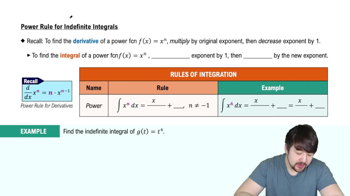
Recall the power rule for antiderivatives: For \(x^n\), the antiderivative is \(\frac{x^{n+1}}{n+1} + C\), provided \(n \neq -1\).
Apply the power rule by increasing the exponent by 1: \(-\frac{3}{2} + 1 = -\frac{1}{2}\).
Write the antiderivative as \(-\frac{1}{2} \cdot \frac{x^{-\frac{1}{2}}}{-\frac{1}{2}} + C\).
Simplify the expression and add the constant of integration \(C\) to complete the antiderivative.

비슷한 문제에 대한 검증된 영상 답변:

이 영상 해법은 위 문제에 도움이 된다고 튜터들이 추천한 것입니다.
영상 길이:
2m
도움이 되었나요?

주요 개념

질문에 올바르게 답하기 위해 반드시 이해해야 하는 핵심 개념들은 다음과 같습니다.

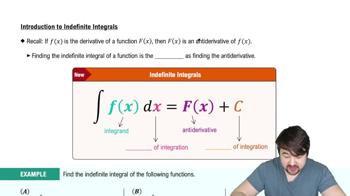
Antiderivatives (Indefinite Integrals)

An antiderivative of a function is another function whose derivative equals the original function. Finding antiderivatives involves reversing differentiation, often using known integral formulas. The result includes a constant of integration since differentiation of a constant is zero.
추천 영상:
가이드 코스
05:04
Introduction to Indefinite Integrals

Power Rule for Integration

The power rule for integration states that ∫x^n dx = (x^(n+1))/(n+1) + C, for any real number n ≠ -1. This rule is essential for integrating functions with variable exponents, including negative and fractional powers, by increasing the exponent by one and dividing by the new exponent.
추천 영상:
가이드 코스
04:04
Power Rule for Indefinite Integrals

Verification by Differentiation

After finding an antiderivative, differentiating it should return the original function. This step confirms the correctness of the antiderivative and helps identify any mistakes in the integration process.
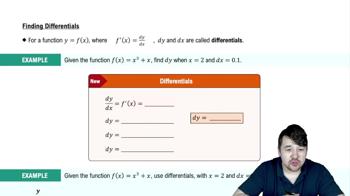
추천 영상:
가이드 코스
05:53
Finding Differentials
관련 실천
교과서 질문

Finding Antiderivatives

In Exercises 1–16, find an antiderivative for each function. Do as many as you can mentally. Check your answers by differentiation.

1/(3³√x)

37
views

교과서 질문

Finding Antiderivatives

In Exercises 1–16, find an antiderivative for each function. Do as many as you can mentally. Check your answers by differentiation.

1 / 2x³

37
views
교과서 질문

Checking Antiderivative Formulas


Right, or wrong? Say which for each formula and give a brief reason for each answer.


∫3(2x + 1)² dx = (2x + 1)³ + C

24
views
교과서 질문

[Technology Exercise] 17. Designing a suitcase A 24-in.-by-36-in. sheet of cardboard is folded in half to form a 24-in.-by-18-in. rectangle as shown in the accompanying figure. Then four congruent squares of side length x are cut from the corners of the folded rectangle. The sheet is unfolded, and the six tabs are folded up to form a box with sides and a lid.

" style="" width="400">

b. Find the domain of V for the problem situation and graph V over this domain.

170
views
교과서 질문

Analyzing Functions from Derivatives


Answer the following questions about the functions whose derivatives are given in Exercises 1–14:


b. On what open intervals is f increasing or decreasing?


f′(x) = x(x − 1)

194
views
교과서 질문

Analyzing Functions from Derivatives


Answer the following questions about the functions whose derivatives are given in Exercises 1–14:


b. On what open intervals is f increasing or decreasing?


f′(x) = 1− 4/x², x ≠ 0

161
views