Ch. 4 - Applications of Derivatives
Hass - Thomas' Calculus 15th Edition
Hass15th EditionThomas' CalculusISBN: 9780137616077당신이 사용하는 게 아니라요?교과서 변경
4장, 문제 4.1.43

Finding Critical Points


In Exercises 41–50, determine all critical points and all domain endpoints for each function.


f(x) = x(4 − x)³

검증된 단계별 안내
1
First, understand that critical points occur where the derivative of the function is zero or undefined. Begin by finding the derivative of the function f(x) = x(4 - x)^3.
Apply the product rule to differentiate f(x) = x(4 - x)^3. The product rule states that if you have a function h(x) = u(x)v(x), then h'(x) = u'(x)v(x) + u(x)v'(x). Here, u(x) = x and v(x) = (4 - x)^3.
Differentiate u(x) = x to get u'(x) = 1. Next, differentiate v(x) = (4 - x)^3 using the chain rule. The chain rule states that if you have a composite function g(h(x)), then the derivative is g'(h(x)) * h'(x). Let g(y) = y^3 and h(x) = 4 - x, then g'(y) = 3y^2 and h'(x) = -1.
Combine the results from the product and chain rules to find f'(x). Substitute u'(x), v(x), u(x), and v'(x) into the product rule formula: f'(x) = 1 * (4 - x)^3 + x * 3(4 - x)^2 * (-1). Simplify this expression.
Set the derivative f'(x) equal to zero and solve for x to find the critical points. Also, consider the endpoints of the domain of f(x), which are determined by the context of the problem or any given interval.

비슷한 문제에 대한 검증된 영상 답변:

이 영상 해법은 위 문제에 도움이 된다고 튜터들이 추천한 것입니다.
영상 길이:
5m
도움이 되었나요?

주요 개념

질문에 올바르게 답하기 위해 반드시 이해해야 하는 핵심 개념들은 다음과 같습니다.

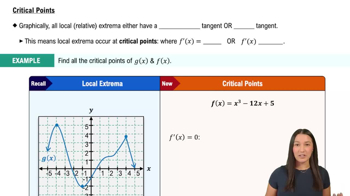
Critical Points

Critical points of a function occur where its derivative is zero or undefined. These points are important because they can indicate local maxima, minima, or points of inflection. To find critical points, take the derivative of the function and solve for the values of x where the derivative equals zero or does not exist.
추천 영상:
04:50
Critical Points

Derivative

The derivative of a function represents the rate at which the function's value changes with respect to changes in its input. It is a fundamental tool in calculus for analyzing the behavior of functions. For the function f(x) = x(4 − x)³, use the product rule and chain rule to find its derivative, which is essential for identifying critical points.
추천 영상:

Domain Endpoints

Domain endpoints are the boundary values of the domain of a function, where the function is defined. These points are crucial when analyzing a function's behavior over its entire domain, especially when determining absolute extrema. For polynomial functions like f(x) = x(4 − x)³, the domain is typically all real numbers, but endpoints are considered in restricted domains.
추천 영상:
가이드 코스
5:10
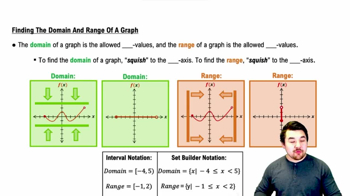
Finding the Domain and Range of a Graph
관련 실천
교과서 질문

35. Determine the dimensions of the rectangle of largest area that can be inscribed in the right triangle shown in the accompanying figure.

377
views

교과서 질문

110. Suppose the derivative of the function y = f(x) is

y'=(x-1)^22(x-2)(x-4).

At what points, if any, does the graph of f have a local minimum, local maximum, or

point of inflection?

166
views
교과서 질문

In Exercises 9–66, graph the function using appropriate methods from the graphing procedures presented just before Example 9, identifying the coordinates of any local extreme points and inflection points. Then find coordinates of absolute extreme points, if any.

y = 1 / (x² - 1)

101
views
교과서 질문

Finding Functions from Derivatives


In Exercises 37–40, find the function with the given derivative whose graph passes through the point P.


f'(x) = 2x − 1, P(0,0)

190
views
교과서 질문

22. A window is in the form of a rectangle surmounted by a semicircle. The rectangle is of clear glass, whereas the semicircle is of tinted glass that transmits only half as much light per unit area as clear glass does. The total perimeter is fixed. Find the proportions of the window that will admit the most light. Neglect the thickness of the frame.

" style="" width="180">

175
views
교과서 질문

Checking the Mean Value Theorem


Which of the functions in Exercises 7–12 satisfy the hypotheses of the Mean Value Theorem on the given interval, and which do not? Give reasons for your answers.


f(x) = x⁴ᐟ⁵, [0, 1]

177
views