Ch. 4 - Applications of Derivatives
Hass - Thomas' Calculus 15th Edition
Hass15th EditionThomas' CalculusISBN: 9780137616077당신이 사용하는 게 아니라요?교과서 변경
4장, 문제 4.1.47

Finding Critical Points


In Exercises 41–50, determine all critical points and all domain endpoints for each function.


y = x² − 32√x

검증된 단계별 안내
1
First, identify the domain of the function y = x² − 32√x. Since the square root function √x is only defined for x ≥ 0, the domain of the function is x ≥ 0.
Next, find the derivative of the function y with respect to x. The derivative of y = x² is 2x, and the derivative of −32√x is −16/√x. Therefore, the derivative y' is y' = 2x − 16/√x.
Set the derivative y' equal to zero to find the critical points: 2x − 16/√x = 0. Solve this equation for x to find the critical points.
To solve 2x − 16/√x = 0, multiply through by √x to eliminate the fraction: 2x√x = 16. Then, solve for x by isolating x on one side of the equation.
Finally, evaluate the function at the endpoints of the domain and at any critical points found to determine the behavior of the function at these points. The endpoint in this case is x = 0, and any critical points found from the previous step.

비슷한 문제에 대한 검증된 영상 답변:

이 영상 해법은 위 문제에 도움이 된다고 튜터들이 추천한 것입니다.
영상 길이:
6m
도움이 되었나요?

주요 개념

질문에 올바르게 답하기 위해 반드시 이해해야 하는 핵심 개념들은 다음과 같습니다.

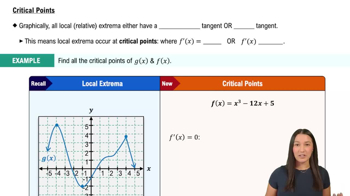
Critical Points

Critical points of a function occur where its derivative is zero or undefined. These points are important because they can indicate local maxima, minima, or points of inflection. To find them, take the derivative of the function and solve for the values of x where the derivative equals zero or does not exist.
추천 영상:
04:50
Critical Points

Derivative

The derivative of a function represents the rate at which the function's value changes with respect to changes in its input. It is a fundamental tool in calculus for analyzing the behavior of functions. For the function y = x² − 32√x, the derivative is found using the power rule and the chain rule, resulting in y' = 2x - 16x^(-1/2).
추천 영상:

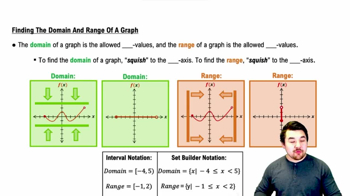
Domain of a Function

The domain of a function is the set of all possible input values (x-values) for which the function is defined. For y = x² − 32√x, the domain is restricted to x ≥ 0 because the square root function is only defined for non-negative numbers. Identifying the domain is crucial for determining endpoints and ensuring the function is evaluated correctly.
추천 영상:
가이드 코스
5:10
Finding the Domain and Range of a Graph
관련 실천
교과서 질문

Finding Indefinite Integrals


In Exercises 17–56, find the most general antiderivative or indefinite integral. You may need to try a solution and then adjust your guess. Check your answers by differentiation.


∫(sin2x − csc²x)dx

27
views

교과서 질문

Absolute Extrema on Finite Closed Intervals


In Exercises 21–36, find the absolute maximum and minimum values of each function on the given interval. Then graph the function. Identify the points on the graph where the absolute extrema occur, and include their coordinates.


f(x) = (2/3)x − 5, −2 ≤ x ≤ 3

210
views
교과서 질문

117. Suppose that the second derivative of the function y = f(x) isy" =(x+1)(x-2).

For what x-values does the graph of f have an inflection point?

222
views
교과서 질문

Initial Value Problems


Solve the initial value problems in Exercises 71–90.


dv/dt = (1/2)sec t tan t, v(0) = 1

13
views
교과서 질문

54. Fermat’s principle in optics Light from a source A is reflected by a plane mirror to a receiver at point B, as shown in the accompanying figure. Show that for the light to obey Fermat’s principle, the angle of incidence must equal the angle of reflection, both measured from the line normal to the reflecting surface. (This result can also be derived without calculus. There is a purely geometric argument, which you may prefer.)

322
views
교과서 질문

Checking the Mean Value Theorem


Find the value or values of c that satisfy the equation (f(b) − f(a)) / (b − a) = f′(c) in the conclusion of the Mean Value Theorem for the functions and intervals in Exercises 1–6.


g(x) = {x³, −2 ≤ x ≤ 0

x², 0 < x ≤ 2

245
views