Ch. 4 - Applications of Derivatives
Hass - Thomas' Calculus 15th Edition
Hass15th EditionThomas' CalculusISBN: 9780137616077당신이 사용하는 게 아니라요?교과서 변경
4장, 문제 4.7.27

Finding Indefinite Integrals


In Exercises 17–56, find the most general antiderivative or indefinite integral. You may need to try a solution and then adjust your guess. Check your answers by differentiation.


∫(√x + ³√x) dx

검증된 단계별 안내
1
Rewrite the integral in terms of exponents to make it easier to integrate. Recall that \( \sqrt{x} = x^{1/2} \) and \( \sqrt[3]{x} = x^{1/3} \). So the integral becomes \( \int \left( x^{1/2} + x^{1/3} \right) \, dx \).
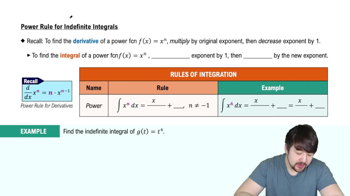
Use the power rule for integration, which states that for any real number \( n \neq -1 \), \( \int x^n \, dx = \frac{x^{n+1}}{n+1} + C \), where \( C \) is the constant of integration.
Apply the power rule separately to each term inside the integral: \( \int x^{1/2} \, dx = \frac{x^{1/2 + 1}}{1/2 + 1} + C_1 = \frac{x^{3/2}}{3/2} + C_1 \) and \( \int x^{1/3} \, dx = \frac{x^{1/3 + 1}}{1/3 + 1} + C_2 = \frac{x^{4/3}}{4/3} + C_2 \).
Simplify the fractions in the denominators by multiplying numerator and denominator appropriately: \( \frac{x^{3/2}}{3/2} = \frac{2}{3} x^{3/2} \) and \( \frac{x^{4/3}}{4/3} = \frac{3}{4} x^{4/3} \).
Combine the results and write the most general antiderivative as \( \frac{2}{3} x^{3/2} + \frac{3}{4} x^{4/3} + C \), where \( C \) is the constant of integration. To verify, differentiate this expression and check if you get back the original integrand.

비슷한 문제에 대한 검증된 영상 답변:

이 영상 해법은 위 문제에 도움이 된다고 튜터들이 추천한 것입니다.
영상 길이:
2m
도움이 되었나요?

주요 개념

질문에 올바르게 답하기 위해 반드시 이해해야 하는 핵심 개념들은 다음과 같습니다.

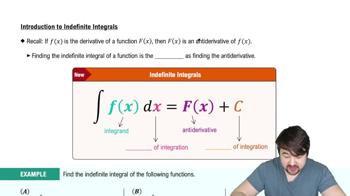
Indefinite Integral (Antiderivative)

An indefinite integral represents the most general form of the antiderivative of a function, including a constant of integration. It reverses differentiation, finding a function whose derivative matches the integrand. For example, ∫f(x) dx = F(x) + C, where F'(x) = f(x).
추천 영상:
가이드 코스
05:04
Introduction to Indefinite Integrals

Power Rule for Integration

The power rule states that ∫x^n dx = (x^(n+1))/(n+1) + C for any real number n ≠ -1. This rule is essential for integrating terms like √x (x^(1/2)) and ³√x (x^(1/3)) by rewriting roots as fractional exponents and applying the formula.
추천 영상:
가이드 코스
04:04
Power Rule for Indefinite Integrals

Verification by Differentiation

After finding an antiderivative, differentiating it should return the original integrand. This step confirms the correctness of the integral solution. It ensures no algebraic errors occurred during integration and that the constant of integration is properly accounted for.
추천 영상:
가이드 코스
05:53
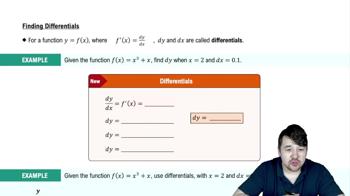
Finding Differentials