Ch. 4 - Applications of Derivatives
Hass - Thomas' Calculus 15th Edition
Hass15th EditionThomas' CalculusISBN: 9780137616077당신이 사용하는 게 아니라요?교과서 변경
4장, 문제 4.4.4

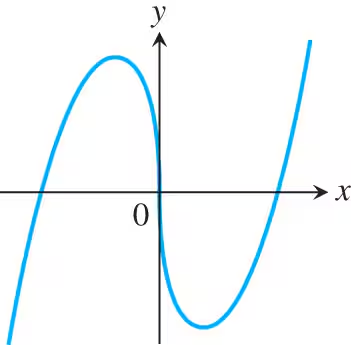
Identify the inflection points and local maxima and minima of the functions graphed in Exercises 1–8. Identify the open intervals on which the functions are differentiable and the graphs are concave up and concave down.
4. y=9/14x^(1/3)(x^2-7)

검증된 단계별 안내
1
To find the inflection points, local maxima, and minima, start by taking the first derivative of the function y = \(\frac{9}{14}\)x^{\(\frac{1}{3}\)}(x^2 - 7). Use the product rule: if y = u*v, then y' = u'v + uv'.
Calculate the first derivative: Let u = \(\frac{9}{14}\)x^{\(\frac{1}{3}\)} and v = (x^2 - 7). Find u' and v'. u' = \(\frac{3}{14}\)x^{-\(\frac{2}{3}\)} and v' = 2x.
Substitute u, u', v, and v' into the product rule formula to find y': y' = \(\frac{3}{14}\)x^{-\(\frac{2}{3}\)}(x^2 - 7) + \(\frac{9}{14}\)x^{\(\frac{1}{3}\)}(2x).
To find critical points, set y' = 0 and solve for x. These points will help identify local maxima and minima. Analyze the sign changes of y' around these points to determine the nature of each critical point.
To find inflection points, take the second derivative of y and set it equal to zero. Solve for x to find where the concavity changes. Analyze the intervals where the second derivative is positive (concave up) and negative (concave down).

비슷한 문제에 대한 검증된 영상 답변:

이 영상 해법은 위 문제에 도움이 된다고 튜터들이 추천한 것입니다.
영상 길이:
10m
도움이 되었나요?

주요 개념

질문에 올바르게 답하기 위해 반드시 이해해야 하는 핵심 개념들은 다음과 같습니다.

Inflection Points

Inflection points occur where the concavity of a function changes from concave up to concave down or vice versa. To find these points, we need to determine where the second derivative of the function equals zero or is undefined, and verify a change in concavity. These points are crucial for understanding the overall shape and behavior of the graph.
추천 영상:
04:50
Critical Points

Local Maxima and Minima

Local maxima and minima are points where a function reaches a highest or lowest value, respectively, within a certain interval. These can be found by setting the first derivative to zero and using the second derivative test to confirm the nature of the critical points. Identifying these points helps in understanding the peaks and troughs of the graph.
추천 영상:
07:09
The First Derivative Test: Finding Local Extrema

Concavity and Differentiability

Concavity describes the direction a graph curves, either upwards (concave up) or downwards (concave down). A function is differentiable on intervals where it is smooth and continuous, without sharp corners or cusps. Analyzing concavity and differentiability provides insights into the function's behavior and helps identify intervals of interest for further analysis.
추천 영상:
05:59
Determining Concavity Given a Function