Ch. 4 - Applications of Derivatives
Hass - Thomas' Calculus 15th Edition
Hass15th EditionThomas' CalculusISBN: 9780137616077당신이 사용하는 게 아니라요?교과서 변경
4장, 문제 4.3.62

Identifying Extrema


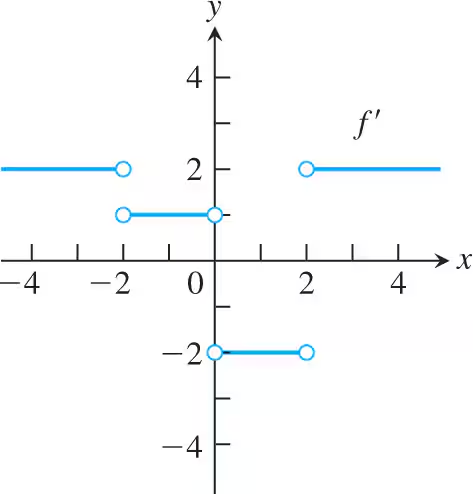
In Exercises 61 and 62, the graph of f' is given. Assume that f is continuous, and determine the x-values corresponding to local minima and local maxima.


검증된 단계별 안내
1
Examine the graph of f'. The graph shows horizontal lines, indicating constant values of f' over intervals.
Identify the intervals where f' is positive, negative, or zero. Positive values of f' suggest f is increasing, negative values suggest f is decreasing, and zero values suggest potential extrema.
Look for points where f' changes sign. These points are candidates for local extrema. A change from positive to negative indicates a local maximum, while a change from negative to positive indicates a local minimum.
In the graph, f' is positive for x < 0, zero at x = 0, and negative for x > 0. This suggests a local maximum at x = 0.
Verify the continuity of f at the identified points. Since f is continuous, the behavior of f' at these points confirms the presence of local extrema.

비슷한 문제에 대한 검증된 영상 답변:

이 영상 해법은 위 문제에 도움이 된다고 튜터들이 추천한 것입니다.
영상 길이:
3m

주요 개념

질문에 올바르게 답하기 위해 반드시 이해해야 하는 핵심 개념들은 다음과 같습니다.

Derivative and Critical Points

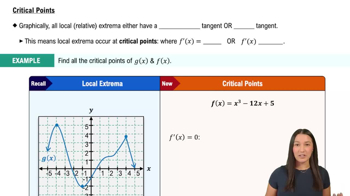
The derivative of a function, denoted as f', represents the rate of change of the function f. Critical points occur where the derivative is zero or undefined, indicating potential locations for local maxima or minima. Analyzing these points is essential for identifying where the function changes from increasing to decreasing or vice versa.
추천 영상:
04:50
Critical Points

First Derivative Test

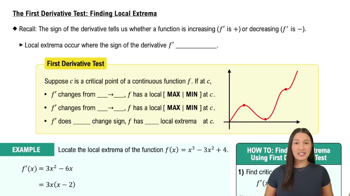
The First Derivative Test is a method used to determine the nature of critical points. If f' changes from positive to negative at a critical point, it indicates a local maximum; if it changes from negative to positive, it indicates a local minimum. This test helps in classifying the extrema based on the behavior of the derivative around the critical points.
추천 영상:
07:09
The First Derivative Test: Finding Local Extrema

Continuity of the Function

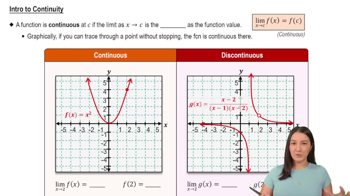
Continuity of a function f is crucial for applying the concepts of calculus effectively. A continuous function does not have breaks, jumps, or holes, ensuring that the behavior of f' accurately reflects the behavior of f. This property guarantees that local extrema identified through the derivative correspond to actual extrema in the function itself.
추천 영상:
05:34
Intro to Continuity
관련 실천
교과서 질문

Identifying Extrema


In Exercises 61 and 62, the graph of f' is given. Assume that f is continuous, and determine the x-values corresponding to local minima and local maxima.


178
views

교과서 질문

In Exercises 1–10, find the extreme values (absolute and local) of the function over its natural domain, and where they occur.

______

y = √𝓍² ― 1

171
views
교과서 질문

54. Fermat’s principle in optics Light from a source A is reflected by a plane mirror to a receiver at point B, as shown in the accompanying figure. Show that for the light to obey Fermat’s principle, the angle of incidence must equal the angle of reflection, both measured from the line normal to the reflecting surface. (This result can also be derived without calculus. There is a purely geometric argument, which you may prefer.)

322
views
교과서 질문

Identify the inflection points and local maxima and minima of the functions graphed in Exercises 1–8. Identify the open intervals on which the functions are differentiable and the graphs are concave up and concave down.

2. y=x^4/4-2x^2+4

223
views
교과서 질문

Absolute Extrema on Finite Closed Intervals


In Exercises 21–36, find the absolute maximum and minimum values of each function on the given interval. Then graph the function. Identify the points on the graph where the absolute extrema occur, and include their coordinates.


f(t) = 2 − |t|, −1 ≤ t ≤ 3

209
views
교과서 질문

Initial Value Problems


Find the curve y = f(x) in the xy-plane that passes through the point (9,4) and whose slope at each point is 3√x.

22
views