Ch. 4 - Applications of Derivatives
Hass - Thomas' Calculus 15th Edition
Hass15th EditionThomas' CalculusISBN: 9780137616077당신이 사용하는 게 아니라요?교과서 변경
4장, 문제 4.7.89

Solve the initial value problems in Exercises 71–90.
y⁽⁴⁾ = −sin t + cos t;
y′′′(0) =7, y′′(0) = y′(0) = −1, y(0) = 0

검증된 단계별 안내
1
Identify the given differential equation and initial conditions: \(y^{(4)} = -\sin t + \cos t\) with \(y'''(0) = 7\), \(y''(0) = -1\), \(y'(0) = -1\), and \(y(0) = 0\).
Integrate the differential equation step-by-step to find \(y(t)\). Since \(y^{(4)}\) is the fourth derivative of \(y\), integrate four times, introducing constants of integration \(C_1\), \(C_2\), \(C_3\), and \(C_4\) at each step.
First integration: Integrate \(y^{(4)} = -\sin t + \cos t\) once to find \(y'''(t)\): \[y'''(t) = \int (-\sin t + \cos t) \, dt = \cos t + \sin t + C_1\]
Second integration: Integrate \(y'''(t)\) to find \(y''(t)\): \[y''(t) = \int (\cos t + \sin t + C_1) \, dt = \sin t - \cos t + C_1 t + C_2\]
Third integration: Integrate \(y''(t)\) to find \(y'(t)\): \[y'(t) = \int (\sin t - \cos t + C_1 t + C_2) \, dt = -\cos t - \sin t + \frac{C_1 t^2}{2} + C_2 t + C_3\] Fourth integration: Integrate \(y'(t)\) to find \(y(t)\): \[y(t) = \int \left(-\cos t - \sin t + \frac{C_1 t^2}{2} + C_2 t + C_3\right) dt = -\sin t + \cos t + \frac{C_1 t^3}{6} + \frac{C_2 t^2}{2} + C_3 t + C_4\]
Use the initial conditions to form a system of equations for \(C_1\), \(C_2\), \(C_3\), and \(C_4\) by substituting \(t=0\) into \(y(0)\), \(y'(0)\), \(y''(0)\), and \(y'''(0)\): - From \(y(0) = 0\), - From \(y'(0) = -1\), - From \(y''(0) = -1\), - From \(y'''(0) = 7\). Solve this system to find the constants.

비슷한 문제에 대한 검증된 영상 답변:

이 영상 해법은 위 문제에 도움이 된다고 튜터들이 추천한 것입니다.
영상 길이:
9m
도움이 되었나요?

주요 개념

질문에 올바르게 답하기 위해 반드시 이해해야 하는 핵심 개념들은 다음과 같습니다.

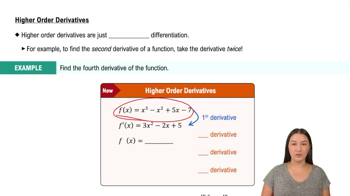
Solving Higher-Order Differential Equations

Higher-order differential equations involve derivatives of order greater than two. To solve them, one typically integrates step-by-step or uses characteristic equations if linear and homogeneous. For nonhomogeneous equations, particular solutions are found and combined with the general solution of the homogeneous part.
추천 영상:
02:42
Higher Order Derivatives

Initial Conditions and Their Role

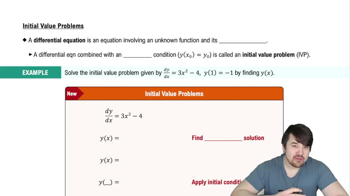
Initial conditions specify the values of a function and its derivatives at a particular point, allowing determination of the constants in the general solution. For a fourth-order equation, four initial conditions are needed to find a unique solution that fits the problem.
추천 영상:
가이드 코스
05:03
Initial Value Problems

Nonhomogeneous Differential Equations and Particular Solutions

Nonhomogeneous differential equations include a forcing function (right-hand side). The solution is the sum of the homogeneous solution and a particular solution that satisfies the nonhomogeneous part, often found using methods like undetermined coefficients or variation of parameters.
추천 영상:
04:00
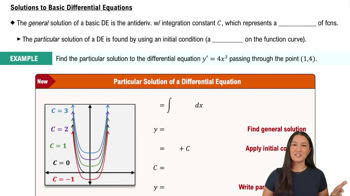
Solutions to Basic Differential Equations