
Ch. 4 - Applications of Derivatives
Hass - Thomas' Calculus 15th Edition
Hass15th EditionThomas' CalculusISBN: 9780137616077당신이 사용하는 게 아니라요?교과서 변경
4장, 문제 4.1.54

Theory and Examples


In Exercises 53 and 54, show that the function has neither an absolute minimum nor an absolute maximum on its natural domain.


y = 3x + tan x

검증된 단계별 안내
1
Identify the natural domain of the function y = 3x + tan(x). The function tan(x) is undefined at odd multiples of π/2, so the natural domain is all real numbers except x = (2n+1)π/2, where n is an integer.
Consider the behavior of the function as x approaches the points where tan(x) is undefined. As x approaches (2n+1)π/2 from the left, tan(x) approaches negative infinity, and from the right, tan(x) approaches positive infinity. This indicates that the function y = 3x + tan(x) has vertical asymptotes at these points.
Analyze the behavior of the function as x approaches positive and negative infinity. As x approaches positive or negative infinity, the linear term 3x dominates, causing the function to increase or decrease without bound.
Since the function has vertical asymptotes and increases or decreases without bound as x approaches infinity or negative infinity, it does not attain a highest or lowest value on its natural domain.
Conclude that the function y = 3x + tan(x) has neither an absolute minimum nor an absolute maximum on its natural domain due to the presence of vertical asymptotes and unbounded behavior at infinity.

비슷한 문제에 대한 검증된 영상 답변:

이 영상 해법은 위 문제에 도움이 된다고 튜터들이 추천한 것입니다.
영상 길이:
2m
도움이 되었나요?

주요 개념

질문에 올바르게 답하기 위해 반드시 이해해야 하는 핵심 개념들은 다음과 같습니다.

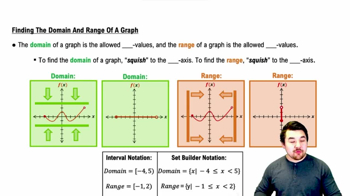
Natural Domain

The natural domain of a function is the set of all possible input values (x-values) for which the function is defined. For the function y = 3x + tan x, the natural domain excludes values where tan x is undefined, such as x = π/2 + kπ, where k is an integer. Understanding the domain is crucial for analyzing the behavior of the function across its entire range.
추천 영상:
5:10
Finding the Domain and Range of a Graph

Absolute Minimum and Maximum

An absolute minimum or maximum refers to the lowest or highest value a function can attain on a given interval or domain. For y = 3x + tan x, determining the existence of absolute extrema involves analyzing the function's behavior and limits, especially considering the periodic nature and asymptotes of the tangent function, which can lead to unbounded behavior.
추천 영상:
03:22
Finding Extrema Graphically Example 4

Behavior of Trigonometric Functions

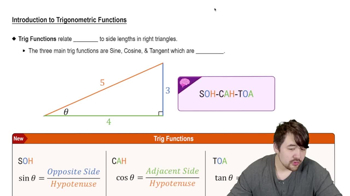
Trigonometric functions like tan x have unique properties, such as periodicity and asymptotes, which affect their graphs and values. The tangent function has vertical asymptotes at odd multiples of π/2, causing it to approach infinity. This behavior is key to understanding why y = 3x + tan x may not have absolute extrema, as the function can increase or decrease without bound near these asymptotes.
추천 영상:
6:04
Introduction to Trigonometric Functions