Ch. 6 - Applications of Definite Integrals
Hass - Thomas' Calculus 15th Edition
Hass15th EditionThomas' CalculusISBN: 9780137616077당신이 사용하는 게 아니라요?교과서 변경
6장, 문제 6.PE.1

Volumes
Find the volumes of the solids in Exercises 1–18.
The solid lies between planes perpendicular to the x-axis at x = 0 and x = 1. The cross-sections perpendicular to the x-axis between these planes are circular disks whose diameters run from the parabola y = x² to the parabola y = √x.

검증된 단계별 안내
1
Identify the region bounded by the two curves: the parabola \(y = x^{2}\) and the curve \(y = \sqrt{x}\), between \(x = 0\) and \(x = 1\).
Since the cross-sections perpendicular to the x-axis are circular disks with diameters running from \(y = x^{2}\) to \(y = \sqrt{x}\), find the length of the diameter at a general point \(x\) by subtracting the lower curve from the upper curve: \(D(x) = \sqrt{x} - x^{2}\).
Calculate the radius of each circular cross-section as half the diameter: \(r(x) = \frac{D(x)}{2} = \frac{\sqrt{x} - x^{2}}{2}\).
Write the area of the circular cross-section as a function of \(x\): \(A(x) = \pi [r(x)]^{2} = \pi \left( \frac{\sqrt{x} - x^{2}}{2} \right)^{2}\).
Set up the volume integral by integrating the cross-sectional area from \(x = 0\) to \(x = 1\): \(V = \int_{0}^{1} A(x) \, dx = \int_{0}^{1} \pi \left( \frac{\sqrt{x} - x^{2}}{2} \right)^{2} \, dx\). This integral will give the volume of the solid.

비슷한 문제에 대한 검증된 영상 답변:

이 영상 해법은 위 문제에 도움이 된다고 튜터들이 추천한 것입니다.
영상 길이:
7m

주요 개념

질문에 올바르게 답하기 위해 반드시 이해해야 하는 핵심 개념들은 다음과 같습니다.

Volume of Solids with Known Cross-Sections

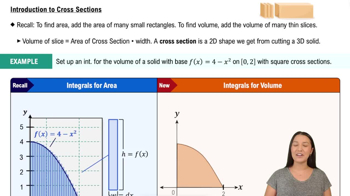
This concept involves finding the volume of a solid by integrating the area of cross-sectional slices perpendicular to an axis. Each cross-section's area is expressed as a function of the variable of integration, and integrating these areas over the given interval yields the total volume.
추천 영상:
05:38
Introduction to Cross Sections

Area of a Circular Cross-Section

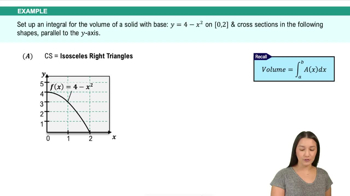
When cross-sections are circular disks, their area is calculated using the formula A = πr², where r is the radius. In this problem, the diameter is given by the vertical distance between two curves, so the radius is half that distance, which must be expressed as a function of x.
추천 영상:
06:18
Introduction to Cross Sections Example 2

Using Functions to Determine Cross-Section Dimensions

The diameters of the circular cross-sections are determined by the vertical distance between two curves, y = x² and y = √x. Understanding how to find this distance at each x-value is essential to express the diameter (and thus radius) as a function for integration.
추천 영상:
05:38
Introduction to Cross Sections
관련 실천
교과서 질문

Volumes

Volume of a solid sphere hole A round hole of radius √3 ft is bored through the center of a solid sphere of radius 2 ft. Find the volume of material removed from the sphere.

44
views

교과서 질문

Volumes

Find the volumes of the solids in Exercises 1–18.

The solid lies between planes perpendicular to the x-axis at x = 0 and x = 4. The cross-sections of the solid perpendicular to the x-axis between these planes are circular disks whose diameters run from the curve x² = 4y to the curve y² = 4x.

28
views
교과서 질문

Centers of Mass and Centroids

Find the centroid of a thin, flat plate covering the region enclosed by the parabolas 𝔂 = 2𝓍² and 𝔂 = 3 ― 𝓍² .

33
views
교과서 질문

Areas of Surfaces of Revolution

In Exercises 23–26, find the areas of the surfaces generated by revolving the curves about the given axes.

_____

y = √2x + 1 , 0 ≤ x ≤ 3 ; x-axis"

32
views
교과서 질문

Work

Pumping a conical tank A right-circular conical tank, point down, with top radius 5 ft and height 10 ft, is filled with a liquid whose weight-density is 60lb/ft³. How much work does it take to pump the liquid to a point 2 ft above the tank? If the pump is driven by a motor rated at 275ft-lb/sec (1/2 hp), how long will it take to empty the tank? 

34
views
교과서 질문

Centers of Mass and Centroids

Find the center of mass of a thin, flat plate covering the region enclosed by the parabola 𝔂² = 𝓍 and the line 𝓍 = 2𝔂 if the density function is δ(𝔂) = 1 + 𝔂. (Use horizontal strips.)

25
views