Ch. 7 - Transcendental Functions
Hass - Thomas' Calculus 15th Edition
Hass15th EditionThomas' CalculusISBN: 9780137616077당신이 사용하는 게 아니라요?교과서 변경
7장, 문제 7.112e

112. True, or false? Give reasons for your answers.
e. sec^(-1)x = O(1)

검증된 단계별 안내
1
Understand the notation: \(\sec^{-1} x\) typically denotes the inverse secant function, also written as \(\operatorname{arcsec}(x)\), which gives the angle whose secant is \(x\).
Recall the definition of Big O notation: \(f(x) = O(g(x))\) means there exist constants \(C > 0\) and \(x_0\) such that for all \(x > x_0\), \(|f(x)| \leq C |g(x)|\). Here, the claim is \(\sec^{-1} x = O(1)\), meaning \(\sec^{-1} x\) is bounded by a constant as \(x\) grows large.
Analyze the behavior of \(\sec^{-1} x\) as \(x \to \infty\): Since \(\sec \theta = x\), for large \(x\), \(\theta = \sec^{-1} x\) approaches \(\frac{\pi}{2}\) from above or below, so \(\sec^{-1} x\) approaches a finite limit.
Conclude that since \(\sec^{-1} x\) approaches a finite constant as \(x\) grows large, it is bounded and thus \(\sec^{-1} x = O(1)\) is true.
Summarize: The statement is true because the inverse secant function does not grow without bound; it approaches a finite limit, satisfying the Big O condition with a constant function.

비슷한 문제에 대한 검증된 영상 답변:

이 영상 해법은 위 문제에 도움이 된다고 튜터들이 추천한 것입니다.
영상 길이:
2m
도움이 되었나요?

주요 개념

질문에 올바르게 답하기 위해 반드시 이해해야 하는 핵심 개념들은 다음과 같습니다.

Big O Notation

Big O notation describes the upper bound of a function's growth rate as the input approaches a limit, often infinity. It characterizes how a function behaves asymptotically, ignoring constant factors and lower-order terms. For example, O(1) means the function remains bounded by a constant regardless of input size.
추천 영상:

Behavior of the Inverse Secant Function (sec⁻¹x)

The inverse secant function, sec⁻¹x, is defined for |x| ≥ 1 and returns the angle whose secant is x. As x grows large, sec⁻¹x increases without bound, meaning it does not remain constant or bounded. Understanding its domain and range is crucial for analyzing its growth.
추천 영상:
06:35
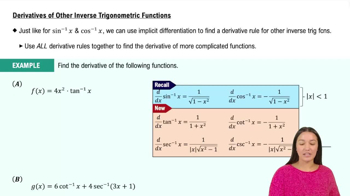
Derivatives of Other Inverse Trigonometric Functions

Asymptotic Analysis of Trigonometric Inverse Functions

Analyzing the asymptotic behavior of inverse trigonometric functions involves studying their limits as the input approaches infinity or other critical points. Unlike bounded functions like arcsin or arctan, sec⁻¹x grows logarithmically or unbounded, affecting its classification in Big O terms.
추천 영상:
06:35
Derivatives of Other Inverse Trigonometric Functions