Ch. 7 - Transcendental Functions
Hass - Thomas' Calculus 15th Edition
Hass15th EditionThomas' CalculusISBN: 9780137616077당신이 사용하는 게 아니라요?교과서 변경
7장, 문제 7.3.143a

143.
a. Show that ∫ ln(x) dx = x ln(x) − x + C.

검증된 단계별 안내
1
Recall the integration by parts formula: \(\int u \, dv = uv - \int v \, du\).
Choose \(u = \ln(x)\) and \(dv = dx\). Then, compute \(du = \frac{1}{x} dx\) and \(v = x\).
Apply the integration by parts formula: \(\int \ln(x) \, dx = x \ln(x) - \int x \cdot \frac{1}{x} \, dx\).
Simplify the integral: \(\int x \cdot \frac{1}{x} \, dx = \int 1 \, dx = x\).
Combine the results to write the integral as \(x \ln(x) - x + C\), where \(C\) is the constant of integration.

비슷한 문제에 대한 검증된 영상 답변:

이 영상 해법은 위 문제에 도움이 된다고 튜터들이 추천한 것입니다.
영상 길이:
2m
도움이 되었나요?

주요 개념

질문에 올바르게 답하기 위해 반드시 이해해야 하는 핵심 개념들은 다음과 같습니다.

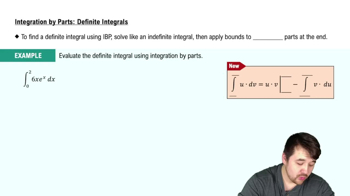
Integration by Parts

Integration by parts is a technique used to integrate products of functions. It is based on the product rule for differentiation and follows the formula ∫u dv = uv − ∫v du. Choosing appropriate u and dv simplifies the integral, as in integrating ln(x) by setting u = ln(x) and dv = dx.
추천 영상:
가이드 코스
06:18
Integration by Parts for Definite Integrals

Properties of the Natural Logarithm Function

The natural logarithm function, ln(x), is defined for x > 0 and has the derivative d/dx [ln(x)] = 1/x. Understanding its domain and derivative is essential when integrating ln(x), as it guides the choice of functions in integration by parts and ensures the integral is correctly evaluated.
추천 영상:
가이드 코스
06:21
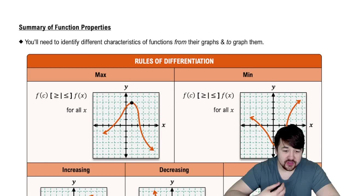
Properties of Functions

Constant of Integration

When computing indefinite integrals, the result includes an arbitrary constant C because differentiation of a constant is zero. This constant accounts for all possible antiderivatives, ensuring the general solution to the integral is complete.
추천 영상:
가이드 코스
06:18
Integration by Parts for Definite Integrals