Ch. 7 - Transcendental Functions
Hass - Thomas' Calculus 15th Edition
Hass15th EditionThomas' CalculusISBN: 9780137616077당신이 사용하는 게 아니라요?교과서 변경
7장, 문제 7.8.2g

2. Which of the following functions grow faster than e^x as x→∞? Which grow at the same rate as e^x? Which grow slower?
g. e^(cos(x))

검증된 단계별 안내
1
Recall that the growth rate of a function as \(x \to \infty\) is determined by its dominant behavior for large \(x\). The function \(e^x\) grows exponentially and very rapidly as \(x\) increases.
Analyze the given function \(g(x) = e^{\cos(x)}\). Since \(\cos(x)\) oscillates between \(-1\) and \(1\), the exponent \(\cos(x)\) does not grow without bound; it remains bounded.
Because \(\cos(x)\) is bounded, \(e^{\cos(x)}\) oscillates between \(e^{-1}\) and \(e^{1}\), which are constant values. This means \(g(x)\) remains bounded and does not increase without limit as \(x \to \infty\).
Compare this behavior to \(e^x\), which grows without bound. Since \(g(x)\) remains bounded, it grows much slower than \(e^x\) as \(x \to \infty\).
Therefore, \(g(x) = e^{\cos(x)}\) grows slower than \(e^x\) as \(x \to \infty\).

비슷한 문제에 대한 검증된 영상 답변:

이 영상 해법은 위 문제에 도움이 된다고 튜터들이 추천한 것입니다.
영상 길이:
3m

주요 개념

질문에 올바르게 답하기 위해 반드시 이해해야 하는 핵심 개념들은 다음과 같습니다.

Exponential Growth and Limits

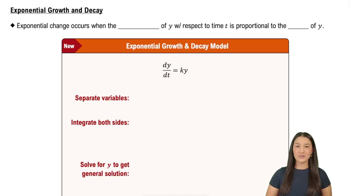
Exponential growth describes functions like e^x that increase rapidly as x approaches infinity. Understanding limits helps compare how fast functions grow by analyzing their behavior as x→∞, determining if one function outpaces, matches, or lags behind another.
추천 영상:
09:29
Exponential Growth & Decay

Behavior of Composite Functions

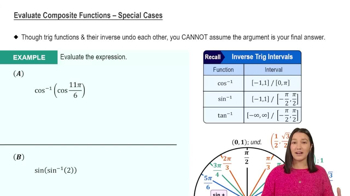
Composite functions like e^(cos(x)) combine an exponential with a bounded function (cos(x)). Since cos(x) oscillates between -1 and 1, e^(cos(x)) oscillates between e^(-1) and e^1, remaining bounded and not growing without limit as x→∞.
추천 영상:
3:48
Evaluate Composite Functions - Special Cases

Growth Rate Comparison

Comparing growth rates involves analyzing dominant terms and their limits. A function that remains bounded or oscillates does not grow faster than an unbounded exponential like e^x. Functions with the same dominant exponential term grow at the same rate, while bounded functions grow slower.
추천 영상:
가이드 코스
04:16
Intro To Related Rates