Ch. 7 - Transcendental Functions
Hass - Thomas' Calculus 15th Edition
Hass15th EditionThomas' CalculusISBN: 9780137616077당신이 사용하는 게 아니라요?교과서 변경
7장, 문제 7.QGYR.23

23. What roles do the functions e^x and ln(x) play in growth comparisons?

검증된 단계별 안내
1
Understand that the function \(e^x\) represents exponential growth, where the rate of increase is proportional to the current value, leading to very rapid growth as \(x\) increases.
Recognize that the function \(\ln(x)\), the natural logarithm, grows much more slowly than any positive power of \(x\) and certainly slower than exponential functions; it is the inverse of the exponential function \(e^x\).
When comparing growth rates, \(e^x\) grows faster than any polynomial or logarithmic function, while \(\ln(x)\) grows slower than any positive power of \(x\).
Use limits to compare growth rates formally, for example, evaluate \(\lim_{x \to \infty} \frac{\ln(x)}{x^a} = 0\) for any \(a > 0\), showing logarithmic growth is negligible compared to polynomial growth, and \(\lim_{x \to \infty} \frac{x^a}{e^x} = 0\), showing exponential growth dominates polynomial growth.
Summarize that \(e^x\) serves as a benchmark for rapid growth, while \(\ln(x)\) serves as a benchmark for slow growth, making them fundamental in understanding and comparing different types of growth behaviors in calculus.

비슷한 문제에 대한 검증된 영상 답변:

이 영상 해법은 위 문제에 도움이 된다고 튜터들이 추천한 것입니다.
영상 길이:
6m
도움이 되었나요?

주요 개념

질문에 올바르게 답하기 위해 반드시 이해해야 하는 핵심 개념들은 다음과 같습니다.

Exponential Function (e^x)

The exponential function e^x grows at a rate proportional to its current value, leading to rapid increase as x becomes large. It serves as a benchmark for comparing growth rates because it outpaces polynomial and logarithmic functions, illustrating the concept of exponential growth.
추천 영상:
03:39
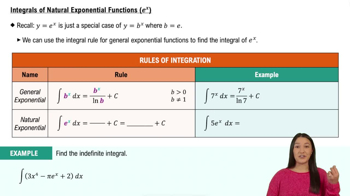
Integrals of Natural Exponential Functions (e^x)

Natural Logarithm Function (ln(x))

The natural logarithm ln(x) is the inverse of the exponential function and grows very slowly compared to polynomial and exponential functions. It is often used to describe slow growth rates and helps in understanding how functions compare when growth is sub-linear.
추천 영상:
05:18
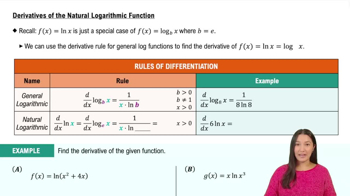
Derivative of the Natural Logarithmic Function

Growth Rate Comparison

Comparing growth rates involves analyzing how functions behave as their input becomes large. Exponential functions grow faster than any polynomial, while logarithmic functions grow slower than any polynomial. Understanding these differences is key to classifying functions by their long-term behavior.
추천 영상:
가이드 코스
04:16
Intro To Related Rates