Ch. 7 - Transcendental Functions
Hass - Thomas' Calculus 15th Edition
Hass15th EditionThomas' CalculusISBN: 9780137616077당신이 사용하는 게 아니라요?교과서 변경
7장, 문제 7.3.37

Evaluate the integrals in Exercises 33–54.
∫8e^(x+1) dx

검증된 단계별 안내
1
Recognize that the integral is of the form \(\int 8 e^{x+1} \, dx\), where the integrand is an exponential function with a linear argument in the exponent.
Use the property of exponents to rewrite the integrand as \$8 e^{x} e^{1}\(, or equivalently factor out the constant \)e^{1}\( since it does not depend on \)x$.
Rewrite the integral as \(8 e^{1} \int e^{x} \, dx\), separating the constant multiplier from the integral.
Recall the integral formula for the exponential function: \(\int e^{x} \, dx = e^{x} + C\), where \(C\) is the constant of integration.
Apply the integral formula and multiply back by the constants to express the antiderivative as \(8 e^{1} e^{x} + C\), which can be combined as \(8 e^{x+1} + C\).

비슷한 문제에 대한 검증된 영상 답변:

이 영상 해법은 위 문제에 도움이 된다고 튜터들이 추천한 것입니다.
영상 길이:
1m
도움이 되었나요?

주요 개념

질문에 올바르게 답하기 위해 반드시 이해해야 하는 핵심 개념들은 다음과 같습니다.

Integration of Exponential Functions

Integrating exponential functions involves reversing differentiation. For functions like e^(ax+b), the integral is (1/a)e^(ax+b) + C, where a and b are constants. Recognizing the inner function helps apply the correct formula.
추천 영상:
05:11
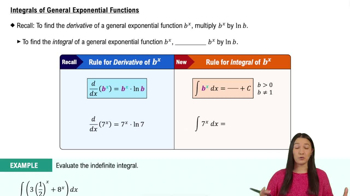
Integrals of General Exponential Functions

Constant Multiple Rule

The constant multiple rule states that a constant factor can be pulled out of the integral. For example, ∫k*f(x) dx = k*∫f(x) dx. This simplifies integration by isolating constants from variable expressions.
추천 영상:
04:02
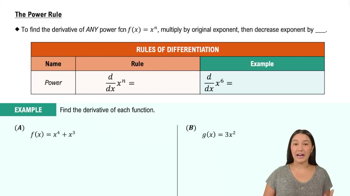
The Power Rule

Indefinite Integrals and Integration Constants

Indefinite integrals represent families of functions differing by a constant, denoted as + C. This constant accounts for all possible antiderivatives since differentiation of a constant is zero.
추천 영상:
05:04
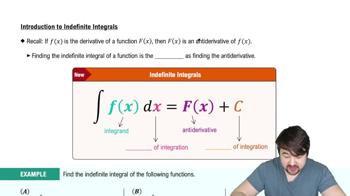
Introduction to Indefinite Integrals