Ch. 7 - Transcendental Functions
Hass - Thomas' Calculus 15th Edition
Hass15th EditionThomas' CalculusISBN: 9780137616077당신이 사용하는 게 아니라요?교과서 변경
7장, 문제 7.3.35

Evaluate the integrals in Exercises 33–54.
∫(from ln3 to ln2) (e^x) dx

검증된 단계별 안내
1
Identify the integral to be evaluated: \(\int_{\ln 3}^{\ln 2} e^{x} \, dx\).
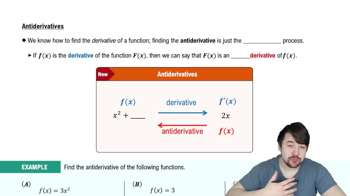
Recall the antiderivative of the integrand \(e^{x}\), which is \(e^{x}\) itself.
Apply the Fundamental Theorem of Calculus, which states that \(\int_{a}^{b} f(x) \, dx = F(b) - F(a)\), where \(F\) is an antiderivative of \(f\).
Substitute the limits of integration into the antiderivative: calculate \(e^{\ln 2} - e^{\ln 3}\).
Simplify the expressions using the property \(e^{\ln a} = a\) to rewrite the result in terms of numbers.

비슷한 문제에 대한 검증된 영상 답변:

이 영상 해법은 위 문제에 도움이 된다고 튜터들이 추천한 것입니다.
영상 길이:
1m
도움이 되었나요?

주요 개념

질문에 올바르게 답하기 위해 반드시 이해해야 하는 핵심 개념들은 다음과 같습니다.

Definite Integral

A definite integral calculates the net area under a curve between two specific limits. It is represented as ∫ from a to b of f(x) dx, where a and b are the lower and upper bounds. Evaluating a definite integral involves finding the antiderivative and then applying the Fundamental Theorem of Calculus.
추천 영상:
가이드 코스
05:43
Definition of the Definite Integral

Antiderivative of the Exponential Function

The antiderivative of e^x is e^x itself, since the derivative of e^x is e^x. This property simplifies integration of exponential functions, allowing direct substitution of the limits after integration.
추천 영상:
가이드 코스
05:50
Antiderivatives

Properties of the Natural Logarithm

The natural logarithm ln(x) is the inverse of the exponential function e^x. Understanding that e^(ln a) = a helps simplify expressions when evaluating definite integrals with logarithmic limits, making it easier to compute exact values.
추천 영상:
05:36
Change of Base Property