

Ch. 7 - Transcendental Functions
Hass - Thomas' Calculus 15th Edition
Hass15th EditionThomas' CalculusISBN: 9780137616077당신이 사용하는 게 아니라요?교과서 변경
7장, 문제 7.7.69b

Evaluate the integrals in Exercises 67–74 in terms of
b. natural logarithms.
69. ∫(from 5/4 to 2)dx/(1-x²)

검증된 단계별 안내
1
Recognize that the integral is of the form \( \int \frac{dx}{1 - x^2} \), which can be rewritten using partial fractions since \(1 - x^2 = (1 - x)(1 + x)\).
Set up the partial fraction decomposition: \( \frac{1}{1 - x^2} = \frac{A}{1 - x} + \frac{B}{1 + x} \).
Solve for constants \(A\) and \(B\) by multiplying both sides by \(1 - x^2\) and equating coefficients or substituting convenient values for \(x\).
Rewrite the integral as the sum of two simpler integrals: \( \int \frac{A}{1 - x} dx + \int \frac{B}{1 + x} dx \), and integrate each term separately, recalling that \( \int \frac{1}{a - x} dx = -\ln|a - x| + C \) and \( \int \frac{1}{a + x} dx = \ln|a + x| + C \).
Apply the definite integral limits from \( \frac{5}{4} \) to \( 2 \) to the resulting expression involving natural logarithms, and write the answer in terms of natural logarithms without simplifying the numerical value.

비슷한 문제에 대한 검증된 영상 답변:

이 영상 해법은 위 문제에 도움이 된다고 튜터들이 추천한 것입니다.
영상 길이:
2m
도움이 되었나요?

주요 개념

질문에 올바르게 답하기 위해 반드시 이해해야 하는 핵심 개념들은 다음과 같습니다.

Definite Integrals

A definite integral calculates the net area under a curve between two specific limits. It is evaluated by finding the antiderivative of the integrand and then applying the Fundamental Theorem of Calculus to subtract the values at the upper and lower bounds.
추천 영상:
가이드 코스
05:43
Definition of the Definite Integral

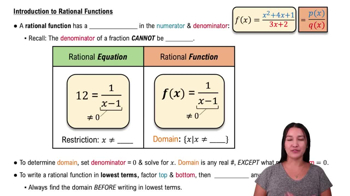
Integration of Rational Functions

Integrating rational functions often involves algebraic manipulation such as partial fraction decomposition. This technique breaks a complex fraction into simpler terms that are easier to integrate, especially when the denominator factors into linear or quadratic terms.
추천 영상:
6:04
Intro to Rational Functions

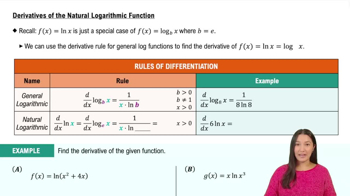
Natural Logarithm in Integration

The natural logarithm function, ln(x), frequently appears as the antiderivative of functions of the form 1/x or similar rational expressions. Recognizing when an integral results in a logarithmic function is key to expressing the solution in terms of natural logarithms.
추천 영상:
05:18
Derivative of the Natural Logarithmic Function