Ch. 7 - Transcendental Functions
Hass - Thomas' Calculus 15th Edition
Hass15th EditionThomas' CalculusISBN: 9780137616077당신이 사용하는 게 아니라요?교과서 변경
7장, 문제 7.3.87

Evaluate the integrals in Exercises 87–96.
87. ∫ 5ˣ dx

검증된 단계별 안내
1
Recognize that the integral involves an exponential function with base 5, which can be written as \$5^x$.
Recall the general formula for integrating an exponential function with base \(a\): \(\int a^x \, dx = \frac{a^x}{\ln(a)} + C\), where \(a > 0\) and \(a \neq 1\).
Apply this formula to the integral \(\int 5^x \, dx\), substituting \(a = 5\).
Write the integral as \(\int 5^x \, dx = \frac{5^x}{\ln(5)} + C\), where \(C\) is the constant of integration.
This expression represents the antiderivative of \$5^x$.

비슷한 문제에 대한 검증된 영상 답변:

이 영상 해법은 위 문제에 도움이 된다고 튜터들이 추천한 것입니다.
영상 길이:
55s
도움이 되었나요?

주요 개념

질문에 올바르게 답하기 위해 반드시 이해해야 하는 핵심 개념들은 다음과 같습니다.

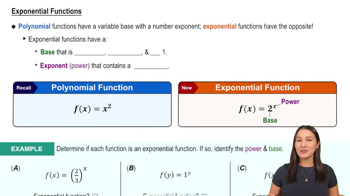
Exponential Functions

An exponential function has the form f(x) = a^x, where the base a is a positive constant. Understanding how these functions behave and their properties is essential for integrating expressions like 5^x.
추천 영상:
6:13
Exponential Functions

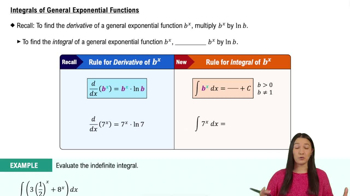
Integration of Exponential Functions

The integral of an exponential function a^x with respect to x is (a^x) / ln(a) + C, where ln(a) is the natural logarithm of the base. This formula is crucial for solving integrals involving exponential terms.
추천 영상:
05:11
Integrals of General Exponential Functions

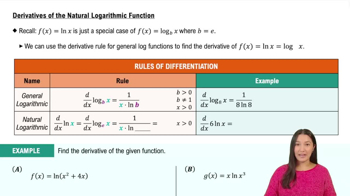
Natural Logarithm (ln)

The natural logarithm ln(x) is the inverse of the exponential function e^x. It appears in the integration formula of exponential functions and is important for simplifying and understanding the results of such integrals.
추천 영상:
05:18
Derivative of the Natural Logarithmic Function