Ch. 7 - Transcendental Functions
Hass - Thomas' Calculus 15th Edition
Hass15th EditionThomas' CalculusISBN: 9780137616077당신이 사용하는 게 아니라요?교과서 변경
7장, 문제 7.3.3

In Exercises 1–4, solve for t.
e^(sqrt(t)) = x^2

검증된 단계별 안내
1
Start with the given equation: \(e^{\sqrt{t}} = x^2\).
Take the natural logarithm (ln) of both sides to eliminate the exponential: \(\ln\left(e^{\sqrt{t}}\right) = \ln\left(x^2\right)\).
Use the logarithm property \(\ln\left(e^a\right) = a\) to simplify the left side: \(\sqrt{t} = \ln\left(x^2\right)\).
Apply the logarithm power rule on the right side: \(\sqrt{t} = 2 \ln(x)\).
Square both sides to solve for \(t\): \(t = \left(2 \ln(x)\right)^2\).

비슷한 문제에 대한 검증된 영상 답변:

이 영상 해법은 위 문제에 도움이 된다고 튜터들이 추천한 것입니다.
영상 길이:
1m
도움이 되었나요?

주요 개념

질문에 올바르게 답하기 위해 반드시 이해해야 하는 핵심 개념들은 다음과 같습니다.

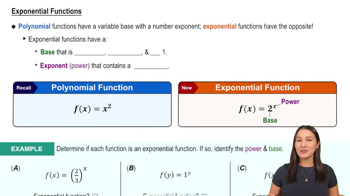
Exponential Functions

An exponential function involves a constant base raised to a variable exponent, such as e^(sqrt(t)). Understanding how to manipulate and invert these functions is essential for solving equations where the variable is in the exponent.
추천 영상:
6:13
Exponential Functions

Square Root and Its Properties

The square root function, denoted sqrt(t), is the inverse of squaring a number. Recognizing how to isolate and handle the square root in an equation is crucial for simplifying and solving for the variable t.
추천 영상:
가이드 코스
06:21
Properties of Functions

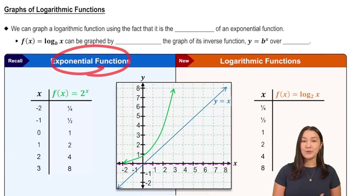
Logarithmic Functions and Their Inverses

Logarithms are the inverse operations of exponentials. Applying the natural logarithm (ln) to both sides of an equation like e^(sqrt(t)) = x^2 allows us to 'undo' the exponential and solve for sqrt(t), facilitating the isolation of t.
추천 영상:
5:26
Graphs of Logarithmic Functions