Ch. 7 - Transcendental Functions
Hass - Thomas' Calculus 15th Edition
Hass15th EditionThomas' CalculusISBN: 9780137616077당신이 사용하는 게 아니라요?교과서 변경
7장, 문제 7.1.44c

In Exercises 41–44:


c. Evaluate df/dx at x = a and df⁻¹/dx at x = f(a) to show that
(df⁻¹/dx)|ₓ₌f(a) = 1 / (df/dx)|ₓ₌a


44. f(x) = 2x², x ≥ 0, a = 5

검증된 단계별 안내
1
First, identify the function and the point at which you need to evaluate the derivatives. Here, the function is \(f(x) = 2x^{2}\) with \(x \geq 0\), and the point is \(a = 5\).
Calculate the derivative of \(f(x)\) with respect to \(x\). Use the power rule: \(\frac{d}{dx} (2x^{2}) = 2 \cdot 2x^{2-1} = 4x\). So, \(\frac{df}{dx} = 4x\).
Evaluate \(\frac{df}{dx}\) at \(x = a = 5\). This gives \(\left. \frac{df}{dx} \right|_{x=5} = 4 \times 5\).
Next, find the inverse function \(f^{-1}(x)\). Since \(f(x) = 2x^{2}\) and \(x \geq 0\), solve for \(x\) in terms of \(y\): \(y = 2x^{2} \Rightarrow x = \sqrt{\frac{y}{2}}\). Thus, \(f^{-1}(x) = \sqrt{\frac{x}{2}}\).
Calculate the derivative of the inverse function \(f^{-1}(x)\) with respect to \(x\). Using the chain rule, \(\frac{d}{dx} \left( \sqrt{\frac{x}{2}} \right) = \frac{1}{2} \left( \frac{x}{2} \right)^{-\frac{1}{2}} \cdot \frac{1}{2} = \frac{1}{4} \left( \frac{x}{2} \right)^{-\frac{1}{2}}\). Then, evaluate this derivative at \(x = f(a) = f(5) = 2 \times 5^{2}\).

비슷한 문제에 대한 검증된 영상 답변:

이 영상 해법은 위 문제에 도움이 된다고 튜터들이 추천한 것입니다.
영상 길이:
3m
도움이 되었나요?

주요 개념

질문에 올바르게 답하기 위해 반드시 이해해야 하는 핵심 개념들은 다음과 같습니다.

Derivative of a Function

The derivative of a function f(x) at a point x = a represents the instantaneous rate of change or slope of the function at that point. It is found by taking the limit of the difference quotient as the interval approaches zero. For example, if f(x) = 2x², then df/dx = 4x, and at x = 5, df/dx = 20.
추천 영상:
06:30
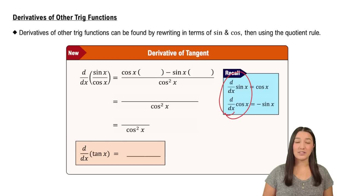
Derivatives of Other Trig Functions

Inverse Function and Its Derivative

An inverse function f⁻¹(x) reverses the effect of f(x), so that f(f⁻¹(x)) = x. The derivative of the inverse function at a point x = f(a) relates to the derivative of the original function at x = a. Specifically, (df⁻¹/dx) at x = f(a) equals the reciprocal of (df/dx) at x = a, provided the derivative is nonzero.
추천 영상:
06:35
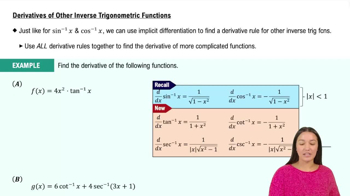
Derivatives of Other Inverse Trigonometric Functions

Chain Rule and Its Application to Inverse Functions

The chain rule states that the derivative of a composite function is the product of the derivatives of the inner and outer functions. Applying this to f(f⁻¹(x)) = x, differentiating both sides yields (df/dx)|ₓ₌f⁻¹(x) * (df⁻¹/dx) = 1. This relationship is key to proving that the derivative of the inverse is the reciprocal of the original function's derivative.
추천 영상:
03:58
The Chain Rule for 3+ Functions