Ch. 7 - Transcendental Functions
Hass - Thomas' Calculus 15th Edition
Hass15th EditionThomas' CalculusISBN: 9780137616077당신이 사용하는 게 아니라요?교과서 변경
7장, 문제 7.1.72e

In Exercises 67–72, you will explore some functions and their inverses together with their derivatives and tangent line approximations at specified points. Perform the following steps using your CAS:
e. Plot the functions f and g, the identity, the two tangent lines, and the line segment joining the points (x_0, f(x_0)) and (f(x_0), x_0). Discuss the symmetries you see across the main diagonal y=x.


72. y= 2-x-x³, -2 ≤ x ≤ 2, x_0 = 3/2

검증된 단계별 안내
1
Identify the given function: \(f(x) = 2 - x - x^{3}\), with the domain \(-2 \leq x \leq 2\), and the point of interest \(x_0 = \frac{3}{2}\).
Calculate the value of the function at \(x_0\): compute \(f\left(\frac{3}{2}\right)\) to find the point \((x_0, f(x_0))\) on the graph of \(f\).
Find the inverse function \(g = f^{-1}\) implicitly or using a CAS, and evaluate \(g\) at \(f(x_0)\) to get the point \((f(x_0), x_0)\) on the graph of \(g\).
Determine the derivatives \(f'(x)\) and \(g'(x)\) at the points \(x_0\) and \(f(x_0)\) respectively, to find the slopes of the tangent lines to \(f\) and \(g\) at these points.
Plot the following on the same coordinate system: the function \(f\), its inverse \(g\), the identity line \(y = x\), the tangent line to \(f\) at \((x_0, f(x_0))\), the tangent line to \(g\) at \((f(x_0), x_0)\), and the line segment joining the points \((x_0, f(x_0))\) and \((f(x_0), x_0)\). Observe and discuss the symmetry of \(f\) and \(g\) about the line \(y = x\).

비슷한 문제에 대한 검증된 영상 답변:

이 영상 해법은 위 문제에 도움이 된다고 튜터들이 추천한 것입니다.
영상 길이:
2m
도움이 되었나요?

주요 개념

질문에 올바르게 답하기 위해 반드시 이해해야 하는 핵심 개념들은 다음과 같습니다.

Inverse Functions and Their Graphical Relationship

An inverse function reverses the roles of inputs and outputs of the original function, such that if y = f(x), then x = f⁻¹(y). Graphically, the function and its inverse are symmetric about the line y = x, meaning each point (a, b) on f corresponds to (b, a) on f⁻¹. Understanding this symmetry is key to analyzing the plots and their relationships.
추천 영상:
4:49
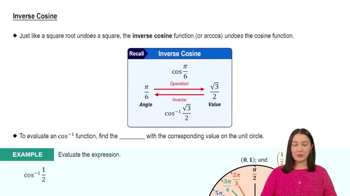
Inverse Cosine

Derivatives and Tangent Lines

The derivative of a function at a point gives the slope of the tangent line to the function's graph at that point. For inverse functions, the derivative at corresponding points are reciprocals, reflecting the slope relationship of their tangent lines. Tangent line approximations help visualize local linear behavior and are essential for comparing f and its inverse.
추천 영상:
가이드 코스
05:13
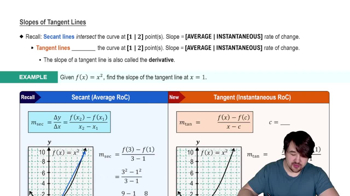
Slopes of Tangent Lines

Symmetry About the Line y = x

The line y = x acts as a mirror for a function and its inverse, meaning their graphs are reflections of each other across this line. This symmetry extends to tangent lines and points, where the segment joining (x₀, f(x₀)) and (f(x₀), x₀) lies on this diagonal. Recognizing this symmetry aids in understanding the geometric relationships in the problem.
추천 영상:
가이드 코스
05:14
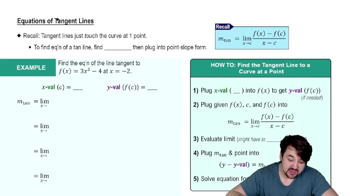
Equations of Tangent Lines