Ch. 7 - Transcendental Functions
Hass - Thomas' Calculus 15th Edition
Hass15th EditionThomas' CalculusISBN: 9780137616077당신이 사용하는 게 아니라요?교과서 변경
7장, 문제 7.1.70b

In Exercises 67–72, you will explore some functions and their inverses together with their derivatives and tangent line approximations at specified points. Perform the following steps using your CAS:


b. Solve the equation y=f(x) for x as a function of y, and name the resulting inverse function g.


70. y= x³/(x²+1), -1 ≤ x ≤ 1, x_0=1/2

검증된 단계별 안내
1
Start with the given function: \(y = \frac{x^{3}}{x^{2} + 1}\), where \(-1 \leq x \leq 1\).
To find the inverse function \(g(y)\), we need to solve the equation \(y = \frac{x^{3}}{x^{2} + 1}\) for \(x\) in terms of \(y\).
Multiply both sides of the equation by \((x^{2} + 1)\) to clear the denominator: \(y(x^{2} + 1) = x^{3}\).
Rewrite this as a polynomial equation in \(x\): \(x^{3} - y x^{2} - y = 0\).
Solve this cubic equation for \(x\) as a function of \(y\). The solution(s) will define the inverse function(s) \(g(y)\). Since the original function is restricted to \(-1 \leq x \leq 1\), select the root that lies within this domain to define the inverse.

비슷한 문제에 대한 검증된 영상 답변:

이 영상 해법은 위 문제에 도움이 된다고 튜터들이 추천한 것입니다.
영상 길이:
7m
도움이 되었나요?

주요 개념

질문에 올바르게 답하기 위해 반드시 이해해야 하는 핵심 개념들은 다음과 같습니다.

Inverse Functions

An inverse function reverses the effect of the original function, swapping inputs and outputs. For a function f(x), its inverse g(y) satisfies g(f(x)) = x. Finding the inverse involves solving y = f(x) for x in terms of y, which may require algebraic manipulation and domain restrictions to ensure the inverse is well-defined.
추천 영상:
4:49
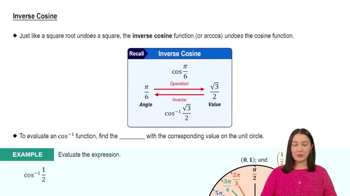
Inverse Cosine

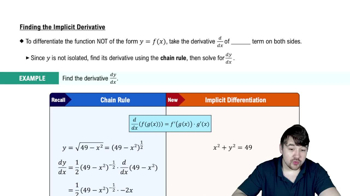
Implicit Differentiation and Derivatives of Inverse Functions

When the inverse function is not given explicitly, implicit differentiation helps find its derivative. The derivative of the inverse at a point is the reciprocal of the derivative of the original function at the corresponding point, i.e., g'(y) = 1 / f'(x). This relationship is crucial for understanding tangent lines and rates of change of inverse functions.
추천 영상:
가이드 코스
05:14
Finding The Implicit Derivative

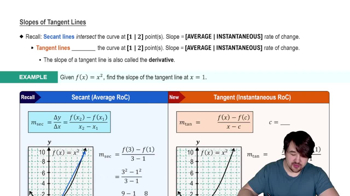
Tangent Line Approximation

Tangent line approximation uses the derivative at a point to approximate the function near that point with a linear function. For a function f at x₀, the tangent line is y = f(x₀) + f'(x₀)(x - x₀). This concept extends to inverse functions, allowing approximation of g(y) near y₀ using the derivative of g.
추천 영상:
가이드 코스
05:13
Slopes of Tangent Lines